The Colorado city will install concrete barriers to physically separate bikes from vehicle lanes.



A press release from the City of Boulder announces the installation of new concrete “tall curbs” on some of the city’s protected bike lanes.
The press release explains, “The tall curbs will replace existing striped buffers and flexible white posts at strategic, prioritized locations on Baseline Road between 30th Street and Foothills Parkway. Ongoing work, along with community feedback, will help inform more significant improvements during the next phase of work beginning in 2024.”
Baseline Road is part of the Core Arterial Network (CAN), “a connected system of protected bicycle lanes, intersection enhancements, pedestrian facilities, and transit facility upgrades that will help reduce the potential for severe crashes and make it safer, more comfortable and more convenient for people to travel in Boulder.”
The project will be the first in the United States to use the more robust lane separators in an effort to improve safety for people on bikes. “Several of the tall curbs will showcase art from a local artist selected from the city’s mural roster.”
FULL STORY: Boulder installs protected bike lane infrastructure new to the U.S.

Houston Mayor Promises Dedicated Austin Street Bike Lane After Public Backlash
Although the one-way bike lane won’t be protected by physical barriers, the proposal is an improvement over the mayor’s initial plan to only include sharrows on the Austin Street project.
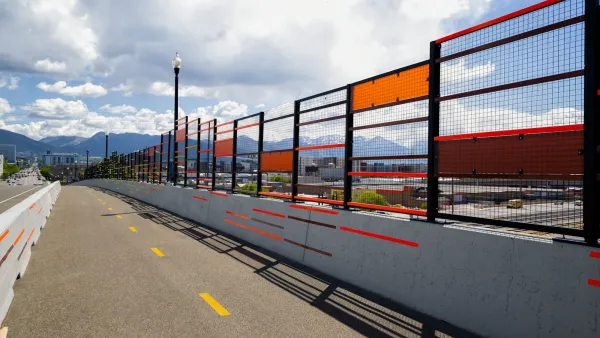
Salt Lake City opens protected bike path on viaduct trail
The 400 South Viaduct Trail features the state's longest continuous piece of public art.

Lawsuit Delays DC Bike Lane Closure Until at Least April
Crashes on 15th Street dropped by 46% since the bike lanes were added.

Planetizen Federal Action Tracker
A weekly monitor of how Trump’s orders and actions are impacting planners and planning in America.

The state-sanctioned urbicide of Austin
People don’t kill cities. Freeways do.

US to reduce Colorado River water deliveries to Mexico
A new Colorado Treaty amendment reduces Mexico’s Colorado River water allocation by 250,000 acre feet.

5 New England states march closer to 800 megawatt wind energy project
Securing federal approval for the project may be complicated under the Trump administration, which has historically been hostile towards domestic wind power.

Baltimore to break ground on $50 million Transit Priority Project
The project will bring faster bus trips, safer streets and better bike connections to Baltimore.

Airbnb launches $250 million 'last-dollar financing' housing accelerator, makes first investment in Austin
The company will put $6.4 million towards affordable housing development in Texas’ capital.

FREE Course: Walkable City 1: Why Walkability?
After describing his path towards focusing on walkability as the essence of good planning, Jeff Speck marches through his five principal reasons for making more walkable places.
Reinventing Malls: Planning Alchemy—Turning Gray Fields Into Gold
The course focuses on the opportunities and imperatives that shape reinvention of mall sites.

Eagle County Government
Harvard University Graduate School of Design
Nashville Planning Department
The Architects Foundation
University of Cincinnati Online
The Pocatello Development Authority
The Urban Renewal Agency of the City of Pocatello
Journal of the American Planning Association