Building cities takes time and resources. Why not spend them on fixing the ones we have?


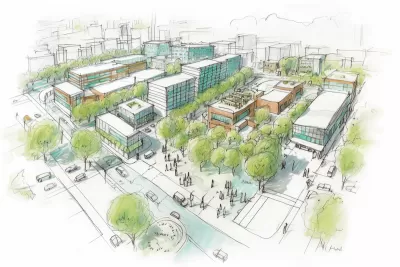
In an article for The Atlantic, Jerusalem Demsas explains why the impulse to just build new cities from scratch felt by many on both the right and the left is not the solution to our urban crises.
As Demsas explains, “The yearning for a blank slate crosses the ideological spectrum, touching socialists, antidevelopment activists, curious policy makers, and, most recently, Silicon Valley investors attempting to build a city from scratch.”
But the idea of building a new city whole cloth often buts up against reality. “‘Organic’ cities, in which firms and workers agglomerate and then begin to demand that governments finance infrastructure, have a preassembled tax base. If you try to build the infrastructure first, paying for it becomes tricky.”
Furthermore, infrastructure is just one piece of a city. “Infrastructure follows people, not the other way around.” People choose which cities to live in for many reasons, a top one being economic opportunity.
The proposed California Forever, a nebulous plan by Silicon Valley investors to build a new town in Northern California, could end up as “sprawl with a prettier face and prettier name” as its residents find themselves forced to travel to bigger cities in the area for jobs and cultural amenities. Solano County, where the project would be built, says the land largely zoned for agricultural use would require rezoning to accommodate greater density.
Demsas points out that every city, once built, will face similar pressures in the future: “It might expand for a while, but it will eventually face the same old problem: residents who don’t want change.”
For Demsas, “Solving the housing crisis doesn’t require inventing new places for people to go; it requires big cities to embrace growth, as they did in the past, and smaller cities to accept change.” It’s not about building new cities, but fixing the ones we already have.
FULL STORY: Why Don’t We Just Build New Cities?


How ‘Opportunity Hoarding’ Harms Communities
Wealthy communities are incorporating their own cities, draining tax revenue and resources away from surrounding neighborhoods.

An AI-Generated Vision of a Silicon Valley Utopia
A proposed plan to build a new city in the Bay Area is light on details and heavy on idyllic renderings.
Why California Should Not, Cannot Solve Its Housing Crisis By Building New Cities
A recent essay advocates for the development of a new city in California to alleviate the state's housing crisis. The argument needs a few tweaks.

Planetizen Federal Action Tracker
A weekly monitor of how Trump’s orders and actions are impacting planners and planning in America.

The state-sanctioned urbicide of Austin
People don’t kill cities. Freeways do.

US to reduce Colorado River water deliveries to Mexico
A new Colorado Treaty amendment reduces Mexico’s Colorado River water allocation by 250,000 acre feet.

Colorado’s Largest Data Center Could Rise Next to Homes — Without a Public Hearing
The proposed campus would consume 11 times the power of Denver International Airport; as it has across the country, opposition mounts.

5 New England states march closer to 800 megawatt wind energy project
Securing federal approval for the project may be complicated under the Trump administration, which has historically been hostile towards domestic wind power.

Baltimore to break ground on $50 million Transit Priority Project
The project will bring faster bus trips, safer streets and better bike connections to Baltimore.

FREE Course: Walkable City 1: Why Walkability?
After describing his path towards focusing on walkability as the essence of good planning, Jeff Speck marches through his five principal reasons for making more walkable places.
Reinventing Malls: Planning Alchemy—Turning Gray Fields Into Gold
The course focuses on the opportunities and imperatives that shape reinvention of mall sites.

Eagle County Government
Harvard University Graduate School of Design
Nashville Planning Department
The Architects Foundation
University of Cincinnati Online
The Pocatello Development Authority
The Urban Renewal Agency of the City of Pocatello
Journal of the American Planning Association