With a major freeway expansion project looming, the Texas capital is seeking federal funding to build several freeway ‘decks’ downtown.


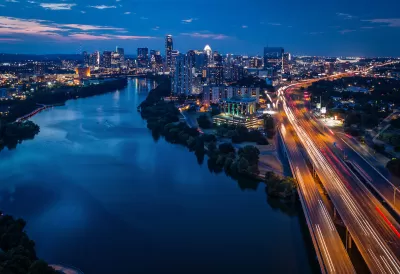
As the Texas Department of Transportation plows ahead with plans to expand Interstate 35 through downtown Austin in spite of local opposition to the project, local leaders hope to secure federal funding for freeway caps to mitigate the impact.
As Chase Rogers reports in the Austin American-Statesman, “Proponents see the inclusion of "caps" and "stitches" over the highway as a means to rectify the downsides of carving a thoroughfare through a major city, including the bifurcation of Austin's neighborhoods.” The new decks could create 30 acres of new real estate for park land, bike paths, and pedestrian walkways.
Due to a deadline from TxDOT, the city must make a final decision and secure funding for the project by December 2024. “TxDOT cannot allocate funding for the decks because that addition is considered cosmetic,” Rogers explains. The city hopes part of the funding will come from a Reconnecting Communities grant.
Elsewhere in the city, “University of Texas officials are exploring how to build three decks over I-35 between Dean Keeton and 15th streets, adjacent to the university's Mike A. Myers Stadium and Moody Center. As imagined in TxDOT renderings, the proposal would create 17 acres of new campus space positioned above the shrunken highway.”
FULL STORY: Austin to seek federal grant for proposed I-35 cap between Cesar Chavez, 4th streets

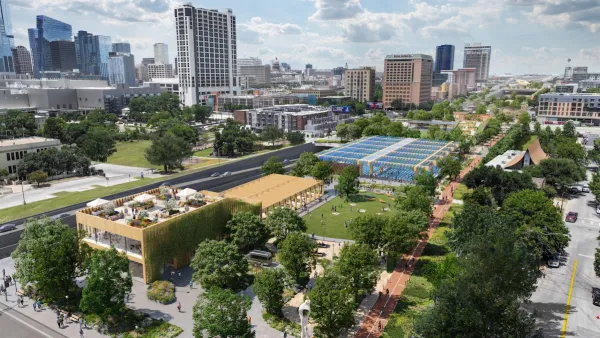
Austin’s Vision for I-35 Cap Parks Takes Final Shape
The city’s plan includes parks, entertainment pavilions, commercial space, sports fields, and other facilities over 30 acres of deck parks spanning a sunken Interstate 35.
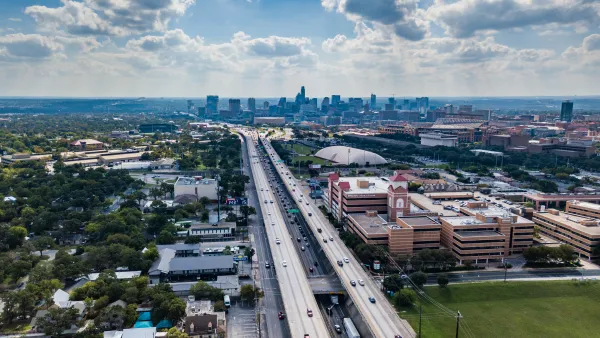
Letter Reveals Changes to I-35 Expansion Plan in Austin
In addition to new HOV lanes and a proposed boardwalk, TxDOT agreed to engineer the freeway for caps in some areas, but the city would have to fund their construction.
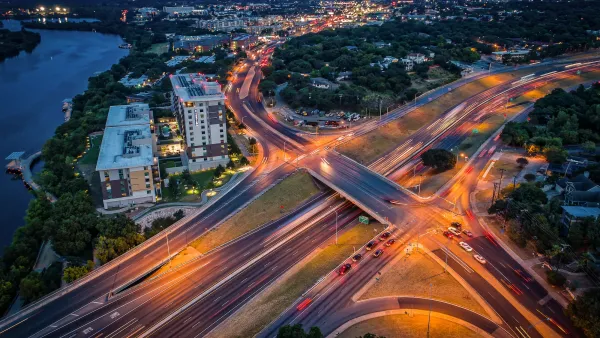
Austin Officials Pump the Brakes on I-35 ‘Cap & Stitch’ Project
The city approved a plan to build cap parks over parts of I-35 less than a year ago.

Planetizen Federal Action Tracker
A weekly monitor of how Trump’s orders and actions are impacting planners and planning in America.

The state-sanctioned urbicide of Austin
People don’t kill cities. Freeways do.

US to reduce Colorado River water deliveries to Mexico
A new Colorado Treaty amendment reduces Mexico’s Colorado River water allocation by 250,000 acre feet.

Mamdani overhauls NYC's Vision Zero plan with 100 new policy goals
The overhaul aims to reduce traffic deaths and make streets safer for pedestrians, cyclists and drivers through lower speed limits, new safety infrastructure and more.

Amtrak not solely to blame for New Jersey commuter rail's unreliability, report finds
A new study from the Garden State Initiative found that NJ Transit’s budget grew 20% across a 4 year period, but reliability declined significantly over the same period.

EPA erases limits on planet-warming pollution from power plants
Under Monday’s plan, power plants would still have some limits on how much mercury, arsenic and other contaminants they can emit.

FREE Course: Walkable City 1: Why Walkability?
After describing his path towards focusing on walkability as the essence of good planning, Jeff Speck marches through his five principal reasons for making more walkable places.
Reinventing Malls: Planning Alchemy—Turning Gray Fields Into Gold
The course focuses on the opportunities and imperatives that shape reinvention of mall sites.

Eagle County Government
Harvard University Graduate School of Design
Nashville Planning Department
The Architects Foundation
University of Cincinnati Online
The Pocatello Development Authority
The Urban Renewal Agency of the City of Pocatello
Journal of the American Planning Association