Critics argue laws preventing unrelated adults from living in the same home fail to understand the modern American household.


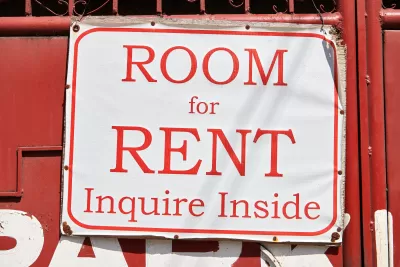
If you’ve ever lived with a group of roommates, it’s possible that the arrangement was technically illegal in your city. As Michael Waters writes in The Atlantic, many U.S. localities have restrictions on the books that limit who can live under one roof. Yet the typical ‘nuclear family’-based household is quickly disappearing, with only 19 percent of U.S. households composed of married couples with children in 2020, down from 44 percent in 1965.
Waters reveals that “A study from last year found that 23 of the 30 largest American metro areas placed limits on the kinds of groups who could buy or rent a single-family home.” And “Though some places permit additional ‘unrelated persons’ (usually two to five) to live under the same roof, others don’t allow any at all.”
These rules, haphazardly enforced, can have serious consequences. “In 2016, the town of Wolcott, Connecticut, refused to allow a group home for people with disabilities to open. A resident of Bar Harbor, Maine, fought the development of a home for seasonal workers (last year, the resident lost the case).” The laws have even affected unmarried couples with children and, in some places, disproportionately affect multigenerational immigrant families or targeted minority groups. “In 1976, Grosse Pointe, Michigan, wielded its ban on unrelated people living together to order out a pair of men—whom press reports implied to be gay, according to [historian Kate Redburn]—from their home.”
Waters concludes, “In the midst of a housing crisis, why restrict living arrangements to any kind of family at all?” More broadly, why should family or relationships be legally defined?
FULL STORY: Where Living With Friends Is Still Technically Illegal


High housing costs force more seniors to live with roommates
Interest in shared living has risen fastest among Americans over 50.

Colorado Ends Non-Family Occupancy Limits
Local jurisdictions will no longer be able to limit how many unrelated adults can live in a household, a move that supporters say will help lower housing costs and help older adults supplement their incomes and stay in their homes.
More Renters Are Living With Roommates
Renters are more likely to double up when the price of rental housing is less affordable.

Planetizen Federal Action Tracker
A weekly monitor of how Trump’s orders and actions are impacting planners and planning in America.

The state-sanctioned urbicide of Austin
People don’t kill cities. Freeways do.

US to reduce Colorado River water deliveries to Mexico
A new Colorado Treaty amendment reduces Mexico’s Colorado River water allocation by 250,000 acre feet.

Mamdani overhauls NYC's Vision Zero plan with 100 new policy goals
The overhaul aims to reduce traffic deaths and make streets safer for pedestrians, cyclists and drivers through lower speed limits, new safety infrastructure and more.

Amtrak not solely to blame for New Jersey commuter rail's unreliability, report finds
A new study from the Garden State Initiative found that NJ Transit’s budget grew 20% across a 4 year period, but reliability declined significantly over the same period.

EPA erases limits on planet-warming pollution from power plants
Under Monday’s plan, power plants would still have some limits on how much mercury, arsenic and other contaminants they can emit.

FREE Course: Walkable City 1: Why Walkability?
After describing his path towards focusing on walkability as the essence of good planning, Jeff Speck marches through his five principal reasons for making more walkable places.
Reinventing Malls: Planning Alchemy—Turning Gray Fields Into Gold
The course focuses on the opportunities and imperatives that shape reinvention of mall sites.

Eagle County Government
Harvard University Graduate School of Design
Nashville Planning Department
The Architects Foundation
University of Cincinnati Online
The Pocatello Development Authority
The Urban Renewal Agency of the City of Pocatello
Journal of the American Planning Association