Lessons from community activists around the country provide insight into how ‘freeway fighters’ can leverage recent momentum against road expansions to have more impact in 2023.


Writing in Streetsblog USA, Ben Crowther, Aaron Brown, and Martha Roskowski outline the goals of ‘freeway fighters’ for 2023, noting the successes of the past year, when federal officials finally began centering the equity impacts of transportation planning and promoting policies that purportedly work to address them, such as the Reconnecting Communities Act.
“But rhetoric (and a small pot of money) aside, the reality is that in 2022, not a single highway was removed to reconnect communities. Moreover, only three major highway expansions were dropped: the 710 Freeway in Los Angeles County and I-25 and C-470 in Denver.”
The article describes five key ways that freeway opponents can be successful in their efforts for freeway removal. These include nationwide coordination with other activists that can lead to federal legislation and support for freeway removal efforts; clear and effective communication strategies to assuage common concerns; access to more legal and traffic modeling expertise; collaboration with community organizers; and funding from state and federal transportation agencies.
Read the full story: Freeway Fighters List Their Top Five Needs For 2023

Congress Moves to End Reconnecting Communities and Related Grants
The House Transportation and Infrastructure Committee moved to rescind funding for the Neighborhood Equity and Access program, which funds highway removals, freeway caps, transit projects, pedestrian infrastructure, and more.
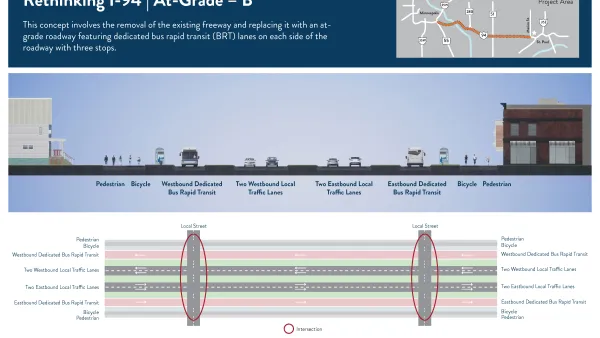
More Options Presented for Minneapolis I-94 Project
Two new proposals for replacing the freeway with at-grade segments offer new visions for the future of downtown Minneapolis.
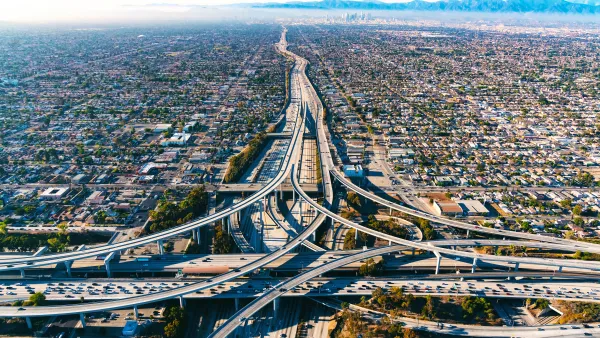
GAO: Reconnecting Communities Lacks Clear Goals and Metrics
The program, aimed at supporting highway removals and other projects that work to reverse the impacts of freeway construction, is light on accountability and performance measures, according to a new report.

Planetizen Federal Action Tracker
A weekly monitor of how Trump’s orders and actions are impacting planners and planning in America.

Eastern Nebraska is running out of electricity
Data centers and electrification are straining eastern Nebraska’s grid, throttling economic development.

Study reveals best places in the U.S. for cycling, walking
New research from Streetlight Data examines bicycle and pedestrian miles per capita in the 100 largest U.S. cities by population.

DSA members accuse Mamdani of 'abandoning values' over housing redevelopment
New York City's mayor plans to replace about 2,000 units of public housing with private, mixed-income housing.

All sides of BRT debate unhappy with CDOT’s most recent move
The Colorado Department of Transportation is no longer considering center-running bus lanes for Colorado Boulevard.

Massachusetts bogs generate both power, and cranberries
Putting solar panels above farmland is one way Massachusetts is advancing toward its goal of net-zero carbon emissions by 2050.

FREE Course: Walkable City 1: Why Walkability?
After describing his path towards focusing on walkability as the essence of good planning, Jeff Speck marches through his five principal reasons for making more walkable places.
Reinventing Malls: Planning Alchemy—Turning Gray Fields Into Gold
The course focuses on the opportunities and imperatives that shape reinvention of mall sites.

City of Rosemead
Rutgers University, Edward J. Bloustein School of Planning and Public Policy
One Hundred Miles
University of Michigan School for Environment and Sustainability (SEAS)
Hunter College, City University of New York (CUNY)
The Architects Foundation
City of Cambridge
The Pocatello Development Authority
The Urban Renewal Agency of the City of Pocatello