It’s been almost three years since the political dynamics of outdoor dining in the United States shifted, suddenly and overwhelmingly. Increasingly, the status quo is being restored.



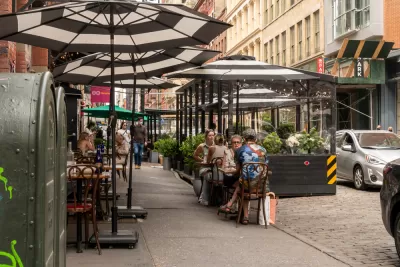
On May 1, 2020, Planetizen picked up a developing story at the intersection of pandemic and planning: practically overnight, the idea of cities blocking off parking spaces and entire streets to motor vehicles had become a reasonable suggestion. Just a few days before, Vilnius, Lithuania had caught the attention of the media in the United States by announcing a large-scale program to create outdoor restaurants and cafes in the city’s historic core. Such a space would provide a place for outdoor socializing and provide more space for restaurants and cafes to operate and stay in business. Suddenly the idea seemed relevant even here in the United States—in New York City— but let the annals of history show that officials in New York trailed John Ernst, mayor of Brookhaven, Georgia, a suburb of Atlanta, to openly pondering the idea of turning parking spaces over to restaurants as a lifeline in those incredibly tenuous times.
In the following weeks and months, cars ceded ground to pedestrians and diners all over the country. In May 2020, I was inspired to write a story about how the world was, against all odds, a little less car-centric. As late as October 2020, Planetizen was picking up news about a lack of public opposition to the trend. A concept with such appeal, we thought, surely would succeed on merits after such a widespread experiment.
A year later, that trend had reversed. The ingredients for a reversal of political fortune had been there since the beginning of the pandemic—more people buying cars, staying off transit, and moving to the suburbs, where even working from home somehow required more trips. Parking was suddenly in short supply and congestion rebounded quickly. Drivers repeatedly careening their vehicles into outdoor dining sheds didn’t help, either.
Now, the outdoor dining programs of the pandemic era are receding, one by one. Al fresco streets, once the talk of the planning profession, are a distant memory. The 15-minute city, a clever phrase used to describe a pedestrian-oriented planning paradigm that had suddenly become much more of a reality thanks to the outdoor dining programs and open streets during the pandemic, is now subject to the brutal and non-sensical debates of the ongoing American culture war.
The New York City Council, home to the nation’s most visited car-free, public space experiments in the days before the pandemic—the High Line and the pedestrian plaza known as Times Square—will soon consider legislation to convert its “permanent” outdoor dining program to seasonal status, according to Streetsblog NYC. Yes, outdoor dining will still be available in New York, but the symbolism of the decision is clear: automobiles are coming for what they lost. New York is hardly alone in chipping away its pandemic-era outdoor dining and street programs. Miami Beach allowed cars to return to Ocean Drive in January 2022. Philadelphia adopted new outdoor dining regulations at the beginning of 2023 that critics said would have an immediately chilling effect on the outdoor dining scene. A few weeks later, the same criticisms were leveled at new outdoor dining regulations proposed in Los Angeles. Santa Cruz, California: same story.
It’s not just outdoor dining in retreat in New York City, either. A once ambitious proposal to expand the mileage of bus-only lanes throughout the city has been dismantled and rescinded at the political whim of car culture.
Three years ago, terrible circumstances ushered in a brief window of time where it was possible to reclaim streets for the benefit of human-scaled activity—meeting and socializing with friends and strangers in public, eating outdoors and soaking in the sights and sounds of the community. While many cities are still committed to permanent outdoor dining programs, advocates are probably feeling a lot like Charlotta Janssen, owner of Chez Oskar, as quoted in the Streetsblog NYC article about the changes coming to New York’s outdoor dining program: “I’m heartbroken, I can’t believe they would do something like that.”

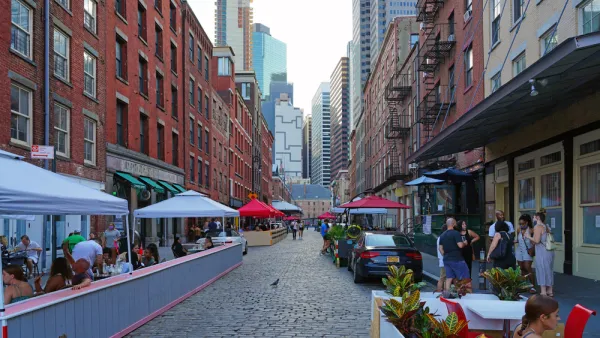
New York Outdoor Dining, Open Streets Programs Now Permanent
New York City will now be measurably less car-centric for the indefinite future.
Open Streets and Outdoor Dining Are Best for Business, Report Says
Most business owners believe that they'd be out of business without on-street parking near their front door. The experience of New York City during the pandemic proves otherwise.
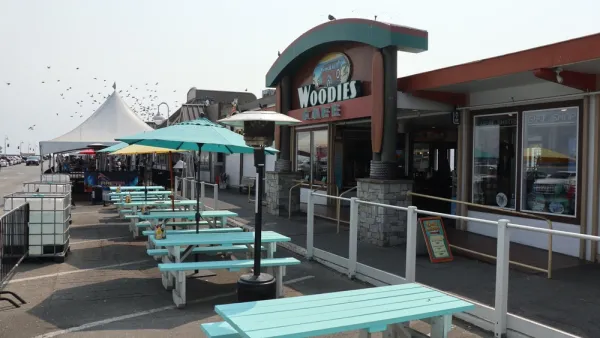
Outdoor Dining Parklets No Longer Cheap and Easy
Cities in Santa Cruz County, California are making outdoor dining laws permanent, and some businesses are getting sticker shock at the extra cost of maintaining the pandemic-era expansion of al fresco dining.

The state-sanctioned urbicide of Austin
People don’t kill cities. Freeways do.

US to reduce Colorado River water deliveries to Mexico
A new Colorado Treaty amendment reduces Mexico’s Colorado River water allocation by 250,000 acre feet.

New Jersey’s second-largest city bans standalone data centers
Jersey City will continue to allow co-location facilities, such as those meant for research institutions that store their own data.

Amtrak not solely to blame for New Jersey commuter rail's unreliability, report finds
A new study from the Garden State Initiative found that NJ Transit’s budget grew 20% across a 4 year period, but reliability declined significantly over the same period.

EPA erases limits on planet-warming pollution from power plants
Under Monday’s plan, power plants would still have some limits on how much mercury, arsenic and other contaminants they can emit.

Phoenix announces new on-demand transit service, more frequent RAPID buses
Both new services will launch in October, and are part of Phoenix's Project Effective Access Solutions for Easing Congestion.

FREE Course: Walkable City 1: Why Walkability?
After describing his path towards focusing on walkability as the essence of good planning, Jeff Speck marches through his five principal reasons for making more walkable places.
Reinventing Malls: Planning Alchemy—Turning Gray Fields Into Gold
The course focuses on the opportunities and imperatives that shape reinvention of mall sites.

Eagle County Government
Harvard University Graduate School of Design
Nashville Planning Department
The Architects Foundation
University of Cincinnati Online
The Pocatello Development Authority
The Urban Renewal Agency of the City of Pocatello
Journal of the American Planning Association

