Two Virginia cities were awarded federal funding aimed at improving connections between neighborhoods cut apart by freeway construction.


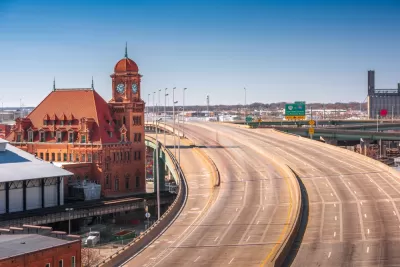
The cities of Richmond and Norfolk, Virginia were awarded almost $3 million in federal funding through the Reconnecting Communities grant program, reports Kassidy Hammond for WRIC.
The grant is targeted at redressing the impacts of Interstates 95 and 64, which isolated the historically Black Jackson Ward neighborhood from the city, cutting off economic opportunities and displacing thousands of residents. The $1.35 million allocated to Richmond will fund a new bridge or freeway ‘lid,’ yet to be determined.
The Reconnecting Communities program is part of the Infrastructure Investment and Jobs Act (IIJA) and one of the first federal efforts that directly acknowledges the destructive impacts of freeway construction on urban neighborhoods. While the program is designed to repair the damage rampant freeway construction inflicted on many communities of color, often dividing neighborhoods and cutting off access to transportation, parks, and urban amenities, some critics warn that transportation departments could use the money to counterintuitively fund road expansion projects.
Read the full story: Richmond receives $1.35M to reconnect historic Jackson Ward neighborhood

Quantifying the Losses Caused by New Freeways
Data shows cities lose millions in potential property taxes when highways displace homes and businesses.
The Limitations of ‘Reconnecting Communities’
The Biden administration has pledged to correct the damage imposed on communities by highways and infrastructure, but many projects are only committing to minor improvements, not transformative changes.
‘Reconnecting Communities’ Could Fund Highway Expansions
Applications to the program reveal a pattern of state agencies requesting funds for projects that perpetuate car-centric development with only nominal equity components.

Planetizen Federal Action Tracker
A weekly monitor of how Trump’s orders and actions are impacting planners and planning in America.

California plans to bury El Niño’s downpour
If the state plays its cards right, it may be able to store a billion acre-feet of El Niño’s water in aquifers.

Chicago breaks ground on $3 billion megadevelopment
The new neighborhood, titled Foundry Park, will one day host 3,700 residences.

Satanic place names
From streams and lakes to valleys and canyons, I mapped more than 1,000 places named after the Devil.

California High-Speed Rail Authority CEO resigns after $600,000 scandal
Under Ian Choudri, the authority used taxpayer dollars to fund first class flights and trips to nightclubs.

Want to study the Missouri River? Soon, you may need unanimous approval from 10 states
Legislation would require 10 governors’ permission to study or build projects moving water outside the basin.

FREE Course: Walkable City 1: Why Walkability?
After describing his path towards focusing on walkability as the essence of good planning, Jeff Speck marches through his five principal reasons for making more walkable places.
Reinventing Malls: Planning Alchemy—Turning Gray Fields Into Gold
The course focuses on the opportunities and imperatives that shape reinvention of mall sites.

City of Rosemead
Rutgers University, Edward J. Bloustein School of Planning and Public Policy
One Hundred Miles
Hunter College, City University of New York (CUNY)
The Architects Foundation
University of Cincinnati Online
City of Cambridge
Montrose County
The Pocatello Development Authority