Despite the popularity of Ballard Avenue’s outdoor dining pergolas, some district board members argue the patios don’t match the district’s historic character.


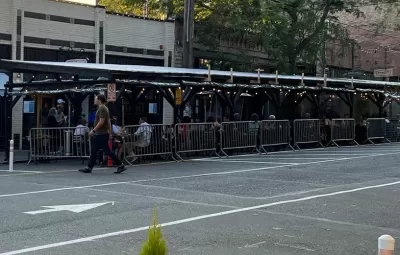
The popular outdoor dining patios created during the pandemic in Seattle’s Ballard Avenue Landmark District could be going away, if the district’s board has its way, reports Ray Dubicki in The Urbanist.
Despite widespread community support, some board members see the eateries as an eyesore that “defile the historic district.” One supportive board member challenged the idea that removing the patios in favor of street parking would improve the situation. “Why are we supporting cars instead of economic vitality,” Miriam Hinden asked.
Because of the historic nature of the district, board members want to require elements that would be cost-prohibitive for most business owners. Legally, because of their location on public right-of-way, the structures will always be deemed temporary by the city.
Dubicki points out that this highlights an inherent flaw in historic district guidelines: they don’t account for new concepts such as parklets or dining patios, leaving it up to board members to debate the appropriate number of pergolas on the street and what materials would fit in with the existing character of the neighborhood. Meanwhile, the street cafes “have done more than revitalize a stretch of shops and restaurants that were hard hit by pandemic shutdowns. They’ve become iconic in their own right.”
The original movement to preserve the district is based on economic revitalization, Dubicki notes. “Not a preservation movement. A revitalization movement.” The aesthetic qualities outlined in the historic district guidelines “are subjectively applied to new structures” anyway, Dubicki argues. “A lively Ballard Avenue is completely within the historic character of the district.”
FULL STORY: Ballard’s Historic District Board Looks to Blow the Roof Off Street Cafes

Opinion: Support Citizen-Led Public Space Projects
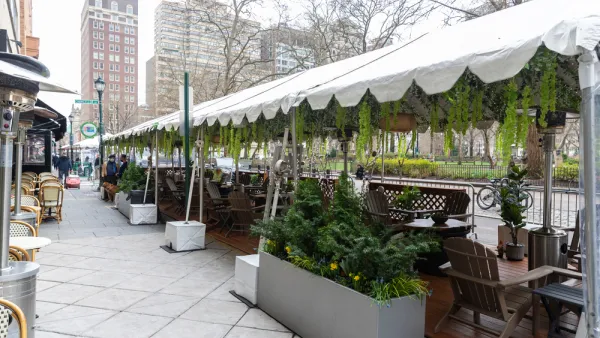
A public space advocate outlines how Philadelphia’s city leaders could support the parklets, plazas, and other public space conversions that proliferated during the pandemic.
San Francisco weighs patio smoking ban
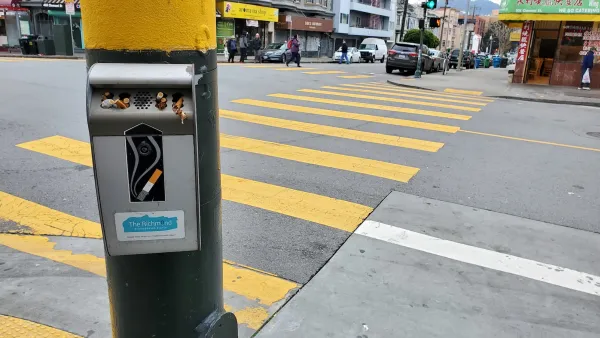
Business owners say the ban could force patrons onto sidewalks and disrupt long-standing bar culture, while proponents of the ordinance say second-hand smoke is a threat to patrons and workers.

DC ‘Streatery’ Fees Could Kill Most Outdoor Dining
The new, permanent outdoor dining program will cost businesses $20 per square foot of dining space, prompting most restaurants to dismantle their Covid-era ‘streateries.’

The state-sanctioned urbicide of Austin
People don’t kill cities. Freeways do.

US to reduce Colorado River water deliveries to Mexico
A new Colorado Treaty amendment reduces Mexico’s Colorado River water allocation by 250,000 acre feet.

New Jersey’s second-largest city bans standalone data centers
Jersey City will continue to allow co-location facilities, such as those meant for research institutions that store their own data.

Amtrak not solely to blame for New Jersey commuter rail's unreliability, report finds
A new study from the Garden State Initiative found that NJ Transit’s budget grew 20% across a 4 year period, but reliability declined significantly over the same period.

EPA erases limits on planet-warming pollution from power plants
Under Monday’s plan, power plants would still have some limits on how much mercury, arsenic and other contaminants they can emit.

Phoenix announces new on-demand transit service, more frequent RAPID buses
Both new services will launch in October, and are part of Phoenix's Project Effective Access Solutions for Easing Congestion.

FREE Course: Walkable City 1: Why Walkability?
After describing his path towards focusing on walkability as the essence of good planning, Jeff Speck marches through his five principal reasons for making more walkable places.
Reinventing Malls: Planning Alchemy—Turning Gray Fields Into Gold
The course focuses on the opportunities and imperatives that shape reinvention of mall sites.


Eagle County Government
Harvard University Graduate School of Design
Nashville Planning Department
The Architects Foundation
University of Cincinnati Online
The Pocatello Development Authority
The Urban Renewal Agency of the City of Pocatello
Journal of the American Planning Association