The former ConocoPhillips campus, built as a self-sufficient complex complete with a lagoon and fitness center, will be repurposed into a mixed-use waterfront development.


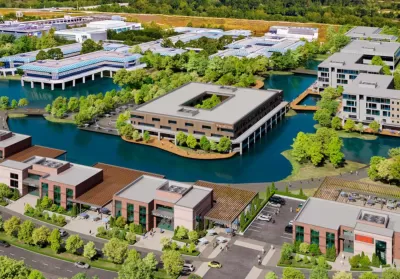
A 63-acre former corporate campus in Houston will be redeveloped into a mixed-use project, reports Trevor Schillaci in the Architect’s Newspaper. “The effort will add new office space, residential, retail, and restaurants around the perimeter of the site.”
The original office park, built for Conoco (later ConocoPhillips) in 1984, “comprises 16 buildings arranged in five groups, with an additional service structure situated at the center of the complex.” Designed as a ‘technoburb,’ the complex aimed to provide everything workers needed: “While much of the complex is programmed as office (and garden) space, the central service building combines parking facilities, a gym, a computer center, staff cafeterias, a credit union, and a travel agency under one roof.”
“Recognizing that a post-pandemic workforce prefers low-rise, low-density workspaces, as opposed to the high-density office towers, the plan proposed by Midway reduces the original 1.3 million-square-foot site down to 650,000 square feet, while repurposing the remaining space to accommodate other uses,” Schillaci explains. Buildings will be remodeled into apartment units, a boutique hotel, as well as restaurants and bars with waterfront views. The developer plans to build on the complex’s sustainability elements by preserving on-site trees and green space and repurposing food and water waste. With demand for physical offices remaining low and the shift to remote work lasting longer than many predicted, adaptive reuse is gaining momentum as property owners look to new uses for now-obsolete office space.
Read the full story: Midway announces redevelopment of Kevin Roche–designed ConocoPhillips office park in Houston

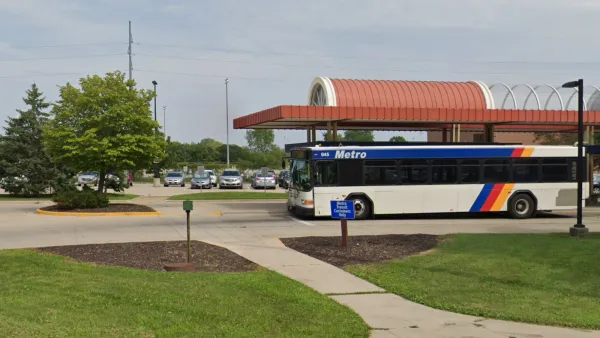
Madison approves hundreds of affordable apartments as deadline for federal funding looms
A recently approved project will bring 163 affordable units to the north side.
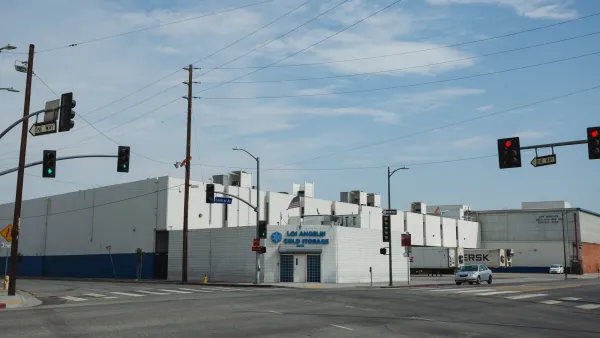
LA approves $2B 'urban village' plan for former cold storage facilities
The project promises an interconnected neighborhood with a focus on public space.
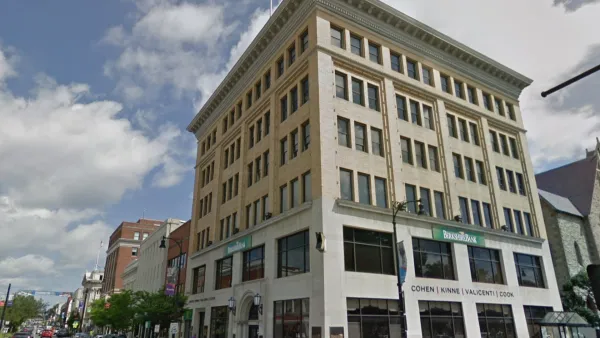
Historic Bank in Pittsfield, Massachusetts to Become Mixed-income Housing
The bank redevelopment project is part of a $140 million state affordable housing initiative.

Planetizen Federal Action Tracker
A weekly monitor of how Trump’s orders and actions are impacting planners and planning in America.

The state-sanctioned urbicide of Austin
People don’t kill cities. Freeways do.
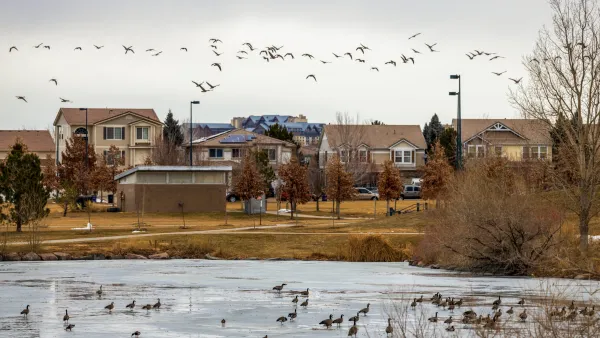
Colorado’s Largest Data Center Could Rise Next to Homes — Without a Public Hearing
The proposed campus would consume 11 times the power of Denver International Airport; as it has across the country, opposition mounts.

Nation's most wind-powered state turns to coal as data centers increase energy demand
For the first time in decades, Iowa has increased its generation of coal power.

NYC cools commuters with city's first rain garden above a bus stop
New York City officials say the plants in the rain garden can absorb 16 gallons of rainwater during heavy storms.

Brightline West’s future may rely on $6 billion federal loan
The company has until Nov. 2 to make a $400 million equity investment into its proposed high-speed rail line.

FREE Course: Walkable City 1: Why Walkability?
After describing his path towards focusing on walkability as the essence of good planning, Jeff Speck marches through his five principal reasons for making more walkable places.
Reinventing Malls: Planning Alchemy—Turning Gray Fields Into Gold
The course focuses on the opportunities and imperatives that shape reinvention of mall sites.

Greater Baltimore Committee
Eagle County Government
Harvard University Graduate School of Design
The Architects Foundation
University of Cincinnati Online
The Pocatello Development Authority
The Urban Renewal Agency of the City of Pocatello
Journal of the American Planning Association