There’s still a long way to go for the nation’s busiest transit system to get back to pre-pandemic ridership levels, but New Yorkers crossed at least one symbolic threshold in 2022.


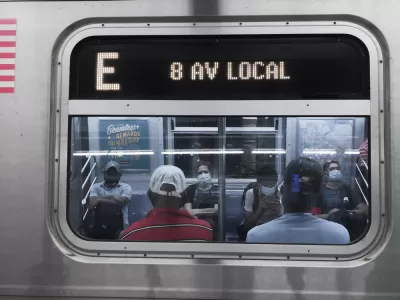
“The MTA announced Tuesday that subway ridership has passed the billion mark in 2022, the first time since before the COVID-19 pandemic,” reports Ben Brachfield.
The billionth rider on the system this year was greeted with fanfare—including a press conference with MTA officials, a new OMNY card pre-loaded with $100, a free membership to the Transit Museum, and a framed work of subway art, according to the article.
Brachfield provides more background on the relative significance of the benchmark:
Crossing the billion threshold is a major COVID-era landmark for the authority, which has struggled to return to its pre-pandemic ridership levels. Annual ridership between 2016 and 2019, the four years before the onset of COVID-19, averaged more than 1.7 billion, according to MTA statistics. But ridership plummeted to 639 million in 2020 as most New Yorkers were urged to quarantine at home, rising to just under 760 million in 2021.
See the Planetizen archive for more on the recent history of transit ridership in New York and elsewhere in the United States.
FULL STORY: MTA surpasses 1 billion subway riders in 2022, a first in COVID era

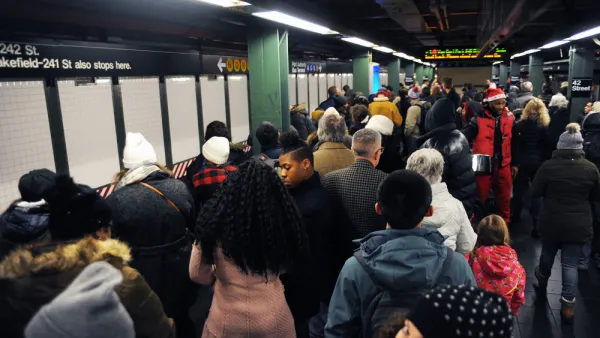
The NYC Subway's Uneven Recovery
As subway riders return in fits and starts, some stations are experiencing a much faster recovery than others.
New York Subway Sets Pandemic Ridership Record
With school back in session and Broadway shows open to the public, subway ridership is surging in New York City, but still well below pre-pandemic levels.
Subway Ridership on a Post-Omicron Rebound in New York City
Checking in with the New York transit system amid a period of relative recovery.

The state-sanctioned urbicide of Austin
People don’t kill cities. Freeways do.

US to reduce Colorado River water deliveries to Mexico
A new Colorado Treaty amendment reduces Mexico’s Colorado River water allocation by 250,000 acre feet.

New Jersey’s second-largest city bans standalone data centers
Jersey City will continue to allow co-location facilities, such as those meant for research institutions that store their own data.

Amtrak not solely to blame for New Jersey commuter rail's unreliability, report finds
A new study from the Garden State Initiative found that NJ Transit’s budget grew 20% across a 4 year period, but reliability declined significantly over the same period.

EPA erases limits on planet-warming pollution from power plants
Under Monday’s plan, power plants would still have some limits on how much mercury, arsenic and other contaminants they can emit.

Phoenix announces new on-demand transit service, more frequent RAPID buses
Both new services will launch in October, and are part of Phoenix's Project Effective Access Solutions for Easing Congestion.

FREE Course: Walkable City 1: Why Walkability?
After describing his path towards focusing on walkability as the essence of good planning, Jeff Speck marches through his five principal reasons for making more walkable places.
Reinventing Malls: Planning Alchemy—Turning Gray Fields Into Gold
The course focuses on the opportunities and imperatives that shape reinvention of mall sites.

Eagle County Government
Harvard University Graduate School of Design
Nashville Planning Department
The Architects Foundation
University of Cincinnati Online
The Pocatello Development Authority
The Urban Renewal Agency of the City of Pocatello
Journal of the American Planning Association