A pair of state legislators hope to make buses free while improving service levels on the Metropolitan Transportation Authority’s (MTA) bus system in New York City. The effort will require a new level of political will for transit.


Two New York Legislators are about to test the limits of the political will to build and fund transit.
Assemblymember Zohran K. Mamdani and state Senator Michael Gianaris proposed a legislative package called “Save the MTA” last week that aims to save the MTA from a looming fiscal emergency by making buses free.
“Free bus service would be phased in over the next four years under the plan, except on express buses. The phase-in would go borough-by-borough, starting with the Bronx in the first year, then Brooklyn the following year, then Queens, and finally Manhattan and Staten Island,” reports Ben Brachfeld in an article for AMNY.
“The proposal would also freeze transit fares at $2.75, rejecting a fare increase sought by the MTA likely to bring the cost of a ride over $3 by 2025. It would also require 6-minutes-or-better subway service and a 20% increase in bus service systemwide,” adds Brachfield.
The entire package is expected to cost $3.26—a total described by Assemblymember Mamdani and State Senator Gianaris as a drop in the bucket of the state’s government.
“Immediate funding could come from remitting the internet sales tax back to the MTA, bringing in about $329 million annually, and by extending the MTA’s ability to engage in “value capture” whereby part of the increased economic activity generated by transit investment, like real estate development, is reinvested in the system,” reports Brachfield. “More money could come from increased taxes on the wealthiest New Yorkers, with progressives recently calling on the state to levy $40 billion in new taxes on the rich to fund essential public services.”
Much of the recent criticism of fare-free transit, including an article published on Planetizen last week, assumes that free transit comes at the expense of capital and service improvements.
FULL STORY: Lawmakers unveil proposal to ‘fix’ MTA, make buses free

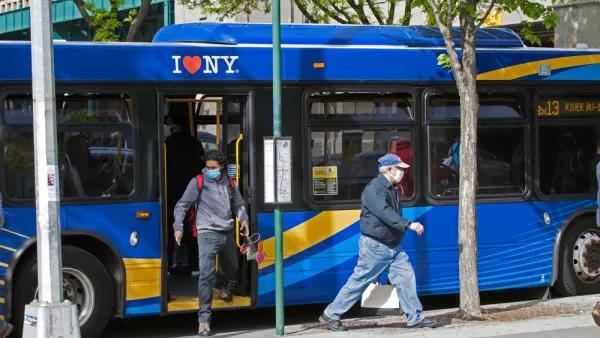
All-Door Boarding Stuck in Neutral in New York City
MTA leadership has decided all-door boarding will lead to fare evasion and isn’t willing to adopt a program that was already well underway.
New York Post-Pandemic First: Big Transit Service Changes
More service on the weekends, less on Monday and Friday, reflects the patterns of post-pandemic transit ridership.
Simple, Easy Ways to Make the Bus an Economic Recovery Tool
A new report by the Bus Turnaround Coalition has a prescription to "build back better": fix the bus.

The state-sanctioned urbicide of Austin
People don’t kill cities. Freeways do.

US to reduce Colorado River water deliveries to Mexico
A new Colorado Treaty amendment reduces Mexico’s Colorado River water allocation by 250,000 acre feet.

New Jersey’s second-largest city bans standalone data centers
Jersey City will continue to allow co-location facilities, such as those meant for research institutions that store their own data.

Amtrak not solely to blame for New Jersey commuter rail's unreliability, report finds
A new study from the Garden State Initiative found that NJ Transit’s budget grew 20% across a 4 year period, but reliability declined significantly over the same period.

EPA erases limits on planet-warming pollution from power plants
Under Monday’s plan, power plants would still have some limits on how much mercury, arsenic and other contaminants they can emit.

Phoenix announces new on-demand transit service, more frequent RAPID buses
Both new services will launch in October, and are part of Phoenix's Project Effective Access Solutions for Easing Congestion.

FREE Course: Walkable City 1: Why Walkability?
After describing his path towards focusing on walkability as the essence of good planning, Jeff Speck marches through his five principal reasons for making more walkable places.
Reinventing Malls: Planning Alchemy—Turning Gray Fields Into Gold
The course focuses on the opportunities and imperatives that shape reinvention of mall sites.

Eagle County Government
Harvard University Graduate School of Design
Nashville Planning Department
The Architects Foundation
University of Cincinnati Online
The Pocatello Development Authority
The Urban Renewal Agency of the City of Pocatello
Journal of the American Planning Association