Nebraska is in the process of criss-crossing the state with a new expressway system. According to state transportation officials, the final push to complete the multi-decade project will be aided by Infrastructure Investment and Jobs Act funding.


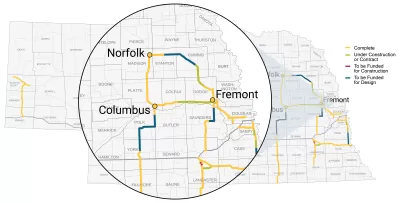
Nebraska is already 30 years and $1.8 billion into a project to add a 600- mile expressway connecting every Nebraska community with more than 15,000 people. The four-lane, divided expressway would connect communities along 16 identified corridors.
Eric Bamer reports in a paywalled article for the Omaha World-Herald that the project is well ahead of schedule and is expected to open four years early, in 2036. The expressway “was projected to be completed in 15 years, but multiple delays extended the project more than three decades.”
After so many decades of delay, the project’s timeline is finally moving the other direction. Nebraska Department of Transportation Director John Selmer told the Nebraska Legislature’s Appropriations Committee recently that barring any “unforeseen issues,” the project could be expected to finish up sooner than originally expected. While work is ongoing, “there’s still about $800 million worth of work to be done, amounting to about 136 miles of roadway,” reports Bamer. “Some of the remaining expressway that’s yet to be completed includes 46 miles encompassing eight projects along U.S. 275 a few miles northwest of Omaha, and 41 miles in six projects along U.S. 81 north of York.”
“Selmer credited the federal bipartisan infrastructure bill that passed in 2021 as one of the main reasons the department was able to accelerate work on the expressway,” according to Bamer.
Read the full story: Nebraska Department of Transportation says 600-mile expressway could be done four years early

Report Criticizes El Paso Interstate Expansion Plan
An independent review of TxDOT's proposed expansion of I-10 through downtown El Paso highlights several flaws and a price tag close to $800 million.

If You Build It, Cars Will Come: the Common-Sense Logic of 'Induced Demand'
Highway expansion has been shown, time and again, to increase traffic and congestion. Cities are finally getting the message.
Opinion: Proposed I-94 Expansion a 'Fiasco' for Milwaukee
An opinion piece published by Urban Milwaukee argues against a proposed expansion of three miles of Interstate 94 in Milwaukee.

Planetizen Federal Action Tracker
A weekly monitor of how Trump’s orders and actions are impacting planners and planning in America.

The state-sanctioned urbicide of Austin
People don’t kill cities. Freeways do.

US to reduce Colorado River water deliveries to Mexico
A new Colorado Treaty amendment reduces Mexico’s Colorado River water allocation by 250,000 acre feet.

Brightline West’s future may rely on $6 billion federal loan
The company has until Nov. 2 to make a $400 million equity investment into its proposed high-speed rail line.

LA Metro’s ultimatum: no extra buses for LA28 if federal funding isn’t imminently secured
If Metro does not provide additional buses, LA28 organizers will have to find a new way to manage Olympic traffic. LA28’s budget does not include a line item for transit.

Colorado’s Largest Data Center Could Rise Next to Homes — Without a Public Hearing
The proposed campus would consume 11 times the power of Denver International Airport; as it has across the country, opposition mounts.

FREE Course: Walkable City 1: Why Walkability?
After describing his path towards focusing on walkability as the essence of good planning, Jeff Speck marches through his five principal reasons for making more walkable places.
Reinventing Malls: Planning Alchemy—Turning Gray Fields Into Gold
The course focuses on the opportunities and imperatives that shape reinvention of mall sites.

Eagle County Government
Harvard University Graduate School of Design
Nashville Planning Department
The Architects Foundation
University of Cincinnati Online
The Pocatello Development Authority
The Urban Renewal Agency of the City of Pocatello
Journal of the American Planning Association