The effort to reclaim public and private spaces from car storage had some setbacks since the days of al fresco and open streets in the first years of Covid-19. But widespread parking reforms and new evidence shows the public is rethinking parking.


The empty streets and suffering business that defined the early months of the Covid-19 pandemic also prompted a fresh look at the public realm, inspiring many cities and communities to reclaim and transform some of the spaces previously reserved for automobile storage into spaces for other activities, such as play, dining, and exercise.
The programs that recovered parking spaces for more active, human uses retreated, to a degree, in the ensuing months and years: while some cities have made outdoor dining programs and parklets permanent, others have reopened streets to cars, rescinded permitting programs, and dialed back ambitions for a post-parking future.
Oliver Moore, writing for the Globe and Mail, makes the case that despite these setbacks for the cause, "the broader pattern is a gradual dismantling of the decades-long assumption that more parking is inherently better." Moore points to the parking reforms underway in Canadian cities, first in Edmonton, followed by more than a dozen other cities as support for the argument (the parking reform trend is also obvious in the United States).
"Perhaps the biggest recent shift in attitudes around parking has been the recognition of just how much value may be forgone by using desirable urban real estate as car storage," writes Moore. A recent report assigns financial value to the choice between parking or other uses of urban space.
Researchers for an association of local business improvement areas estimated that customers spent $181-million in the repurposed parking spaces in the summer of 2021. The same spaces would have generated $3.7-million in parking revenue, according to the local parking authority, and even that modest figure assumed prepandemic levels of demand.
Moore's conclusion, with more examples and and appeals to authority, included in the source article (which requires an email to read for free): people are slowly waking up to the idea that parking doesn't play the same role in cities as it did in the 1950s.
Read the full story: New spin on parking spaces during pandemic reaps benefits

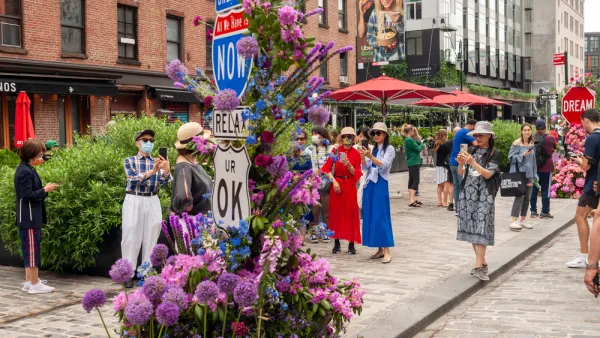
The Tide Has Turned Against Open Streets
Once a promising development for advocates pushing for a less car-centric future in cities, the open streets movement has ceded significant ground to cars since the height of the pandemic.

Pedestrians Briefly Take Back Miami Beach's Ocean Drive
Miami Beach reopened Ocean Drive to vehicles earlier this year at the request of hotel owners. So many pedestrians showed up to the famous street on a weekend earlier this month, however, that cars were blocked once again.
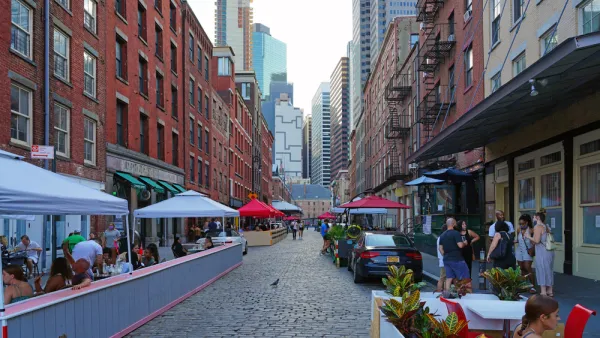
The Next Mayor Will Have to Decide in New York's Post-Pandemic Parking Conflicts
The ongoing political controversy about the priorities of the public realm in New York City is likely to last into the next mayoral administration.

Planetizen Federal Action Tracker
A weekly monitor of how Trump’s orders and actions are impacting planners and planning in America.

Amtrak, CN end decades-long dispute with eight-year agreement
The new operating agreement establishes an updated framework for the companies to work together, including processes to resolve disputes.

Judges permit Denver to divert 77,000 acre feet from the Colorado River for reservoir expansion
Overuse and climate change have caused the Colorado River’s water levels to plummet.

Boston has spent millions making the Green Line more accessible — and there’s no end in sight
While the city has invested millions into expanding and adding platforms to the Green Line to make it more accessible, new train cars set to arrive next year will be too tall for disabled passengers to board without raising the current platforms.

Idaho may see an 18% drop in federal surface transit funding — the largest estimated cut in the US
Transit systems in rural communities are much more reliant on federal funding to provide their services.

How ‘post-disaster gentrification’ alters neighborhoods after natural calamities
After hurricanes, fires or other calamities, the original residents of a community are often replaced by younger, wealthier residents.

FREE Course: Walkable City 1: Why Walkability?
After describing his path towards focusing on walkability as the essence of good planning, Jeff Speck marches through his five principal reasons for making more walkable places.
Reinventing Malls: Planning Alchemy—Turning Gray Fields Into Gold
The course focuses on the opportunities and imperatives that shape reinvention of mall sites.

Harvard University Graduate School of Design
KFH Group Inc.
Greater Baltimore Committee
The Architects Foundation
University of Cincinnati Online
The Pocatello Development Authority
The Urban Renewal Agency of the City of Pocatello