For many people with chronic illnesses, access to public restrooms can be a critical medical issue. Incentivizing businesses to open their restrooms can fill a critical gap in U.S. cities.


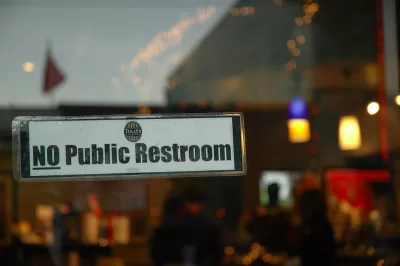
In a piece for Bloomberg CityLab, Michael Osso and Marilyn G. Geller call for a new solution to the “great urban restroom shortage,” an issue Planetizen has highlighted before.
“Most of us have experienced the challenge of finding a public restroom, but for many, restroom access isn’t just a matter of convenience — it’s a serious medical issue,” the authors, respectively the president and CEO of the Crohn’s & Colitis Foundation and the Celiac Disease Foundation, argue. Since many U.S. cities lack adequate restroom facilities, Osso and Geller suggest that, in lieu of a targeted public investment in more public facilities, private businesses should open their restroom doors to the public, and governments should incentivize them to do so through direct payments or tax credits.
We expect the generosity of participating businesses to be fully paid back in the form of increased goodwill — and revenue, above and beyond any incentives. In fact, a recent Crohn’s & Colitis Foundation survey found that more than three-quarters of inflammatory bowel disease (IBD) patients stated that they were more likely to patronize a business if they could find their restrooms on a restroom finder app.
The authors point out that similar incentives to encourage businesses to comply with Americans with Disabilities Act (ADA) guidelines already exist, and restroom incentive programs are popular in Germany and the United Kingdom. Making more restrooms publicly available, they write, can benefit businesses and make cities easier to navigate for more people.
FULL STORY: How to Solve the Great Urban Restroom Shortage

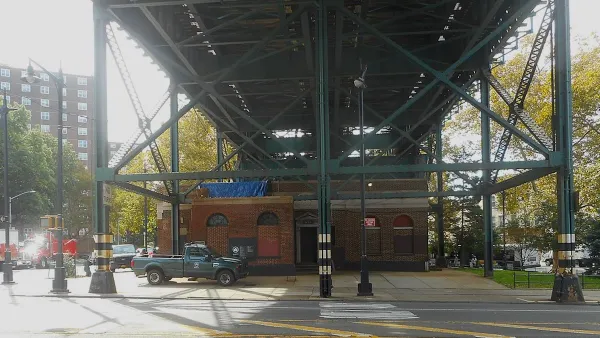
NYC TikToker Helps You Find Public Bathrooms
After starting an interactive map to show public bathroom locations around the city, Teddy Siegel now advocates for local bills that expand public restroom access.

Cities Need More Public Bathrooms–Well Beyond the Pandemic
COVID-19 laid bare the dismal state of public bathrooms in America, and some cities stepped up to add more facilities. But why remove them while the need remains?
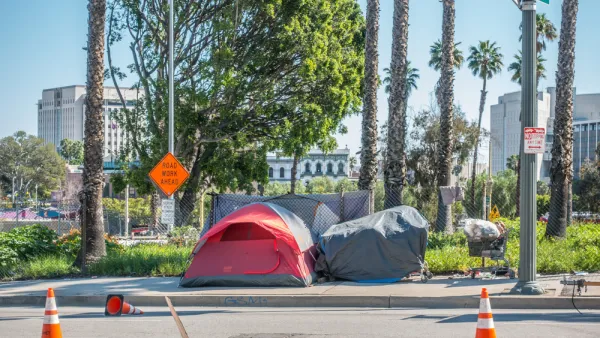
Bad News for L.A.'s Homelessness Strategy: Public Restroom Plan Falls Apart
The city's failure to deliver public restrooms is not the first sign of trouble for its sweeping homelessness plan, but it’s a painful one for the residents of Skid Row.

Planetizen Federal Action Tracker
A weekly monitor of how Trump’s orders and actions are impacting planners and planning in America.

The state-sanctioned urbicide of Austin
People don’t kill cities. Freeways do.

US to reduce Colorado River water deliveries to Mexico
A new Colorado Treaty amendment reduces Mexico’s Colorado River water allocation by 250,000 acre feet.

5 New England states march closer to 800 megawatt wind energy project
Securing federal approval for the project may be complicated under the Trump administration, which has historically been hostile towards domestic wind power.

Baltimore to break ground on $50 million Transit Priority Project
The project will bring faster bus trips, safer streets and better bike connections to Baltimore.

Airbnb launches $250 million 'last-dollar financing' housing accelerator, makes first investment in Austin
The company will put $6.4 million towards affordable housing development in Texas’ capital.

FREE Course: Walkable City 1: Why Walkability?
After describing his path towards focusing on walkability as the essence of good planning, Jeff Speck marches through his five principal reasons for making more walkable places.
Reinventing Malls: Planning Alchemy—Turning Gray Fields Into Gold
The course focuses on the opportunities and imperatives that shape reinvention of mall sites.

Eagle County Government
Harvard University Graduate School of Design
Nashville Planning Department
The Architects Foundation
University of Cincinnati Online
The Pocatello Development Authority
The Urban Renewal Agency of the City of Pocatello
Journal of the American Planning Association