COVID-19 laid bare the dismal state of public bathrooms in America, and some cities stepped up to add more facilities. But why remove them while the need remains?


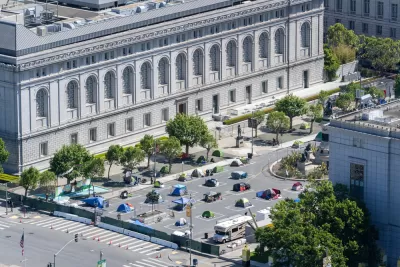
In a move brought on largely by pressure from community activists and reporting from L.A. Taco's Lexis-Olivier Ray, "L.A. City Councilmember Mark Ridley-Thomas filed a motion to extend the program that brought hundreds of hygiene stations to homeless encampments during the pandemic until the end of the year." If passed, the motion would reverse plans to remove the stations, even as COVID-19 infections rise again in Los Angeles.
The program came under fire when, in June, an investigation by Ray found that "vendors failed to service units consistently, despite collecting millions of dollars in payments." The city's sanitation department, meanwhile, did not inspect bathrooms and wash stations daily, despite Mayor Garcetti's promises. "On average, roughly half of the 300 or so city hand-washing stations went unassessed each day. On some days the sanitation department assessed fewer than 50 stations." Some unhoused residents supplemented the stations with soap themselves.
When the pilot program abruptly ended in June, "three councilmembers told L.A. TACO that the abrupt removal of hygiene stations blindsided them, and two councilmembers told us that they didn’t support the removal of units." The new resolution proposes funding 150 stations until the end of the year. Yet Ridley-Thomas and the city council's support of an ordinance that housing advocates say "further criminalizes the unhoused" has critics wondering what good hygiene stations do "if [the unhoused] are in jail for sleeping on the sidewalk?" Advocates and unhoused residents also wonder what will happen after December when, even if the pandemic has subsided, the need for public bathrooms and hygiene stations will still be sharply felt on L.A.'s streets.
Cities around the country are responding to the need for public bathrooms in different ways. San Francisco's mobile pit stop program, which launched in 2014, now consists of 25 staffed bathroom locations and "has widespread support from the mayor and all 11 members of their Board of Supervisors." In Seattle, Washington, hand-washing stations promised in November in response to the pandemic have yet to make it to the city's streets, prompting officials to ask where the $100,000 earmarked by the city council has gone. Officials pointed to "a set of regulatory hurdles for the sinks, ranging from Seattle Plumbing Code rules to Americans with Disabilities Act compliance." Bangor, Maine's city council voted earlier this year to spend roughly $70,000 on four outdoor toilets meant for unhoused residents as well as the general public. In the D.C. area, "the Foggy Bottom and West End Advisory Neighborhood Commission passed a resolution in June, calling on the D.C. Council, plus the District Department of Human Services, to allocate $400,000 to fund mobile sanitation facilities" that include showers and laundry facilities. The San Jose Housing Department's Homeless Response Team coordinates maintenance of portable toilets at several of the city's homeless encampments. Advocates are pushing for more sanctioned encampments that would provide services, "[b]ut a combination of high operation costs and complaints from neighbors who don’t want to live near encampments have kept such camps from being built."
According to an article from the Harvard Civil Rights-Civil Liberties Law Review, while COVID-19 exposed the importance of facilities for public health, "the need for drastic action long precedes the current pandemic. The COVID-19 crisis only magnifies the already shameful lack of sanitation available to people experiencing homelessness" and the myriad ways in which we criminalize being unhoused. "Laws that make public urination a crime make the shortage of public toilets especially unjust, resulting in people experiencing homelessness being further marginalized by the criminal justice system."
"[T]he lack of accessible toilets is emblematic of how unhoused people are made even more vulnerable by social systems that exclude them." As Nicholas Kristof writes in a New York Times op-ed, "this is a class issue. Power brokers who decide on infrastructure priorities can find a restaurant to duck into, while that is less true of a Black teenage boy and utterly untrue of an unwashed homeless person with a shopping cart."
More than a convenience, public bathrooms are a human right.

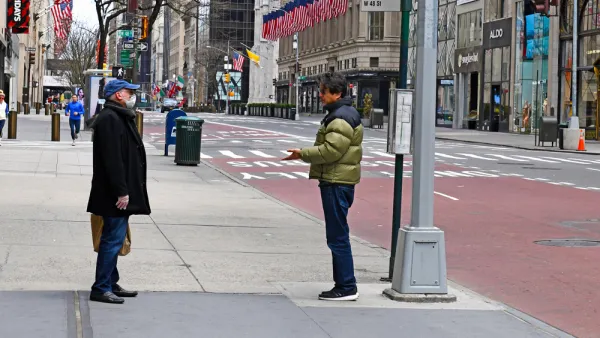
Friday Eye Candy: Covid-19, Then and Now
The New York Times compared images from readers portraying similar scenes in 2020 and 2022.
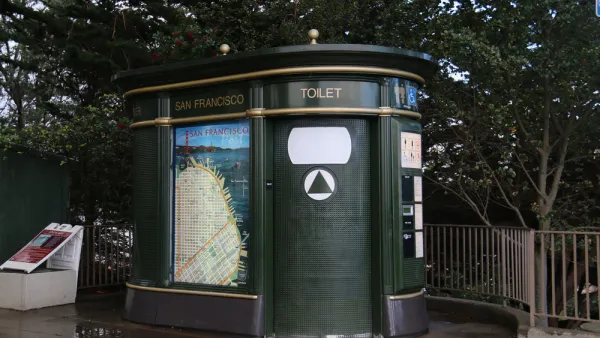
San Francisco’s Tenderloin Makes a Compelling Case for Public Restroom Programs
San Francisco’s Pit Stop program, which provides public restroom facilities to vulnerable and unhoused residents, has helped contribute to a decline in feces-related service calls in the Tenderloin.
What Can Lessons From Traffic Safety Teach About the Covid Response?
Finger waggings aren't effective for pedestrian safety—so why should they work for public health? A "safe system" approach, created for traffic safety in Sweden, offers a model for improved pandemic public health outcomes, according to this opinion.

The state-sanctioned urbicide of Austin
People don’t kill cities. Freeways do.

US to reduce Colorado River water deliveries to Mexico
A new Colorado Treaty amendment reduces Mexico’s Colorado River water allocation by 250,000 acre feet.

New Jersey’s second-largest city bans standalone data centers
Jersey City will continue to allow co-location facilities, such as those meant for research institutions that store their own data.

Amtrak not solely to blame for New Jersey commuter rail's unreliability, report finds
A new study from the Garden State Initiative found that NJ Transit’s budget grew 20% across a 4 year period, but reliability declined significantly over the same period.

EPA erases limits on planet-warming pollution from power plants
Under Monday’s plan, power plants would still have some limits on how much mercury, arsenic and other contaminants they can emit.

Phoenix announces new on-demand transit service, more frequent RAPID buses
Both new services will launch in October, and are part of Phoenix's Project Effective Access Solutions for Easing Congestion.

FREE Course: Walkable City 1: Why Walkability?
After describing his path towards focusing on walkability as the essence of good planning, Jeff Speck marches through his five principal reasons for making more walkable places.
Reinventing Malls: Planning Alchemy—Turning Gray Fields Into Gold
The course focuses on the opportunities and imperatives that shape reinvention of mall sites.

Eagle County Government
Harvard University Graduate School of Design
Nashville Planning Department
The Architects Foundation
University of Cincinnati Online
The Pocatello Development Authority
The Urban Renewal Agency of the City of Pocatello
Journal of the American Planning Association

