The agency argues that the city cannot introduce lane reductions on a state road, putting a long-planned bike lane project in jeopardy and superseding local decisionmaking.


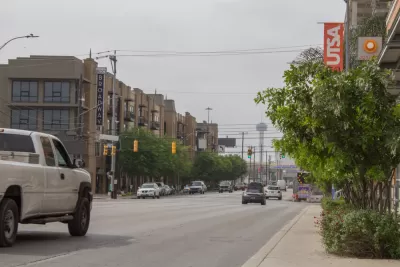
Bike advocates often face an uphill battle in their efforts to build safer bike infrastructure in their cities. But even well-meaning local efforts to improve road conditions for people on bikes can be thwarted by state agencies. This is the case with San Antonio, as reported by Jared Brey in Governing.
“Like a lot of other big cities, San Antonio has tried to make some of its streets safer for bikers and pedestrians. In 2017, voters approved a bond measure to fund a range of public-realm improvements, including 200 miles of new sidewalks.” One project funded by this bond, a two-mile redesign of Broadway that would have added bike lanes, was nixed by the Texas Department of Transportation, who claimed that, as a state route, the road could not be narrowed from its six driving lanes, despite having worked with the city on the project for years.
“The moves are in keeping with state leaders’ focus on reducing traffic congestion on state roads, and part of a broader culture war over transportation” that Planetizen readers are undoubtedly familiar with (see examples here, here, here, and here, for starters). City planning professor Sara Bronin points to the inherent conservative nature of engineers, saying, “What we’re seeing in the traffic context is that the inclination to rely on established safety standards has resulted in complacency, and that has led to these standards not being questioned by the majority of decision-makers.”
For now, San Antonio policymakers are faced with a project in limbo until TxDOT agrees to a plan.
FULL STORY: Can San Antonio Become a Better Bike City? Not on State Roads.


Idaho Bills Limit New Bike Lanes, Sidewalks
Cities in the county surrounding Boise will have to prove a “secondary benefit” before adding bike lanes or sidewalks to road projects.
San Antonio Approves New Downtown Cycletrack
The city will install a one-mile, protected two-way bike lane connecting Flores Street to Interstate 37.

San Antonio Leaders Look to Revive Dormant Bike Plan
The city’s 12-year-old plan to improve its bike network has made little headway. Now, city leaders hope to revitalize the effort.

The state-sanctioned urbicide of Austin
People don’t kill cities. Freeways do.

US to reduce Colorado River water deliveries to Mexico
A new Colorado Treaty amendment reduces Mexico’s Colorado River water allocation by 250,000 acre feet.

New Jersey’s second-largest city bans standalone data centers
Jersey City will continue to allow co-location facilities, such as those meant for research institutions that store their own data.

Amtrak not solely to blame for New Jersey commuter rail's unreliability, report finds
A new study from the Garden State Initiative found that NJ Transit’s budget grew 20% across a 4 year period, but reliability declined significantly over the same period.

EPA erases limits on planet-warming pollution from power plants
Under Monday’s plan, power plants would still have some limits on how much mercury, arsenic and other contaminants they can emit.

Phoenix announces new on-demand transit service, more frequent RAPID buses
Both new services will launch in October, and are part of Phoenix's Project Effective Access Solutions for Easing Congestion.

FREE Course: Walkable City 1: Why Walkability?
After describing his path towards focusing on walkability as the essence of good planning, Jeff Speck marches through his five principal reasons for making more walkable places.
Reinventing Malls: Planning Alchemy—Turning Gray Fields Into Gold
The course focuses on the opportunities and imperatives that shape reinvention of mall sites.

Eagle County Government
Harvard University Graduate School of Design
Nashville Planning Department
The Architects Foundation
University of Cincinnati Online
The Pocatello Development Authority
The Urban Renewal Agency of the City of Pocatello
Journal of the American Planning Association