A lack of access to public transit, scarcer law enforcement, and reduced access to nearby medical care contribute to more risky behavior and more deadly crashes on rural roads.


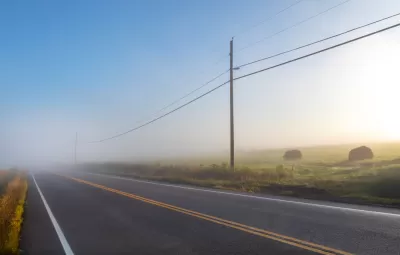
“In a 73-page study released last week by the Governor's Highway Safety Association, America’s Rural Roads: Beautiful and Deadly, researchers found that about 48% of U.S. traffic deaths occurred on rural roads from 2016-20 even though only about 19% of the population lives in rural areas.” Ed Blazina, writing in the Pittsburgh Post-Gazette, outlines the study’s findings.
Common causes of crashes are similar to those in urban areas, which continue to grow in most U.S. cities: “distractions, impaired driving, speeding and not wearing seat belts.” But Blazina notes that these tend to occur at higher rates in rural areas.
In 2020, drivers taking a trip the same length were 62% more likely to die if they were in a rural area rather than an urban area, the study said. A total of 85,002 people died on rural roads in the five-year period, nearly half of all traffic deaths across the country.
Blazina continues, “The study cites a number of reasons that lead to drivers exhibiting risky behavior, including open roads, less law enforcement, longer trips for necessities, limited emergency response from farther away and fewer public transit options.”
The article also details the demographics of fatal rural crashes as compared to urban ones. For example, “More drivers and passengers in cars, trucks and vans died in rural areas (68,709 to 56,998) but urban areas led in deaths involving motorcycles (15,390 to 9,310), pedestrians (25,551 to 5,766) and bicycles (3,375 to 952).” Young people between 20 and 24 face a risk of dying on rural roads twice that of urban youth.
According to the study, “Clearly, a holistic approach is needed to address the rural road safety problem — one that includes both behavioral and infrastructure safety.” Among other infrastructure fixes, curve warnings and high-friction surfaces are two “particularly effective” tools for reducing crashes. “The study recommends that states stress the ‘safe system’ approach in rural areas: safe vehicles, safe roads, safe speeds, safe road users and post-crash care.” The report also suggests reducing speed limits, particularly in areas with limited access to medical facilities.
Read the full story: ‘Beautiful and Deadly’: Rural roads have disproportionate share of traffic deaths
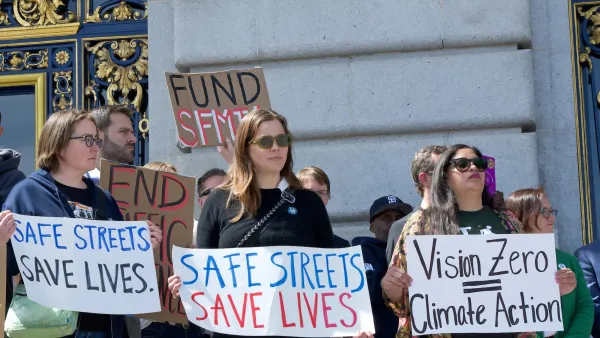
San Francisco Cut Traffic Deaths Almost in Half in 2025
The city credits its Vision Zero strategy and new traffic cameras for reducing the number of deaths and serious injuries on its roads.
Portland Traffic Deaths Surpass 2022 Number
This year, 69 people have died in traffic crashes in Portland, Oregon, nearly twice as many as in 2018, when the city began its Vision Zero program.
Texas Lags on Rural Road Investments
State-administered roads in rural parts of Texas have some of the highest speed limits in the state, and see more fatal crashes than urban roads.

Planetizen Federal Action Tracker
A weekly monitor of how Trump’s orders and actions are impacting planners and planning in America.

California plans to bury El Niño’s downpour
If the state plays its cards right, it may be able to store a billion acre-feet of El Niño’s water in aquifers.

Desperate measures: Advocates weigh draining Lake Powell to fill Colorado River
Draining the reservoir could reduce evaporation losses by a couple hundred thousand acre-feet.

Mamdani’s pied-à-terre tax survives legal challenge
A panel of judges found that the plaintiffs failed to demonstrate injury as a result of New York City's implementation of the tax.

Eastern Nebraska is running out of electricity
Data centers and electrification are straining eastern Nebraska’s grid, throttling economic development.

Seattle passes record-breaking transit services expansion
Proposition 1 will double the city’s transit tax to add 95,000 more bus trips and preserve 180,000 bus trips annually.

FREE Course: Walkable City 1: Why Walkability?
After describing his path towards focusing on walkability as the essence of good planning, Jeff Speck marches through his five principal reasons for making more walkable places.
Reinventing Malls: Planning Alchemy—Turning Gray Fields Into Gold
The course focuses on the opportunities and imperatives that shape reinvention of mall sites.

City of Rosemead
Rutgers University, Edward J. Bloustein School of Planning and Public Policy
One Hundred Miles
University of Michigan School for Environment and Sustainability (SEAS)
Hunter College, City University of New York (CUNY)
The Architects Foundation
City of Cambridge
Montrose County
The Pocatello Development Authority