More questions than answers on the Colorado River this week as the federal government failed to deliver on threats to force Southwest states to cut back on water use.


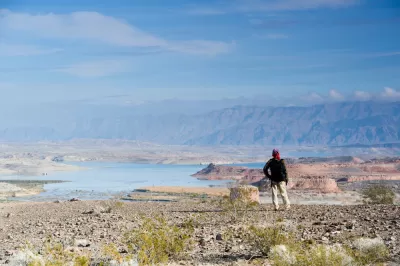
Various levels of government have failed to achieve a lasting agreement on how to cut back water use along the Colorado River, a critical supply of water for 40 million Americans that is dwindling quickly amid a historic drought with very little chance of relief on the horizon.
An article by Nick Bowlin for High Country News summarizes the situation after major developments this week:
In June, the Bureau of Reclamation, the Interior Department agency that manages water infrastructure in the Western U.S., told the seven states involved — the “Upper Basin” states of Colorado, New Mexico, Utah and Wyoming, and the “Lower Basin” states of Arizona, California and Nevada — to cut back substantially on the water they collectively use. Otherwise, the agency warned, it would impose drastic cuts anyway.
However, the states failed to cut a deal. And on Tuesday, Interior Department officials declined to follow through on their threat, leaving a big question mark about how the federal government intends to address an increasingly dire situation.
An August 16 press release from the U.S. Department of the Interior announced decision, calling the need for action “urgent” but producing what Bowlin describes as “meager” cuts—“far less severe” than threatened in July.
According to Bowlin’s analysis, nothing announced by the Department of the Interior goes beyond measures already enacted by the Drought Contingency Plan (DCP) approved by seven U.S. states and Congress in 2019. The DCP already triggered cutbacks on the Upper Colorado River Basin states (i.e., Colorado, Utah, New Mexico, and Wyoming) in January 2021 and again in May 2021.
The reductions announced earlier this week will focus more on the Lower Basin states, Arizona and Nevada. Arizona “will lose 592,000 acre-feet in 2023 — 21% of its annual allotment (this figure includes an existing cutback from last year),” reports Bowlin. “Nevada will lose about 25,000 acre-feet, and Mexico will lose 104,000 acre-feet, or 7% of its annual portion.”
The Department of the Interior’s action was triggered by water levels falling below “Tier 2” levels, as defined by the DCP, on Lake Mead. California, another Lower Basin state, hasn’t lost any of its Colorado River water, yet. The Golden State will lose water when Lake Mead falls below the next shortage level, according to Bowlin.
FULL STORY: The feds declined to seriously cut Colorado River water use. Here’s what that means

More Need Than Ever for Drought Resilience on the Colorado River
The effects of climate change are already cutting deeply into the lifeblood of the U.S. West—the Colorado River.
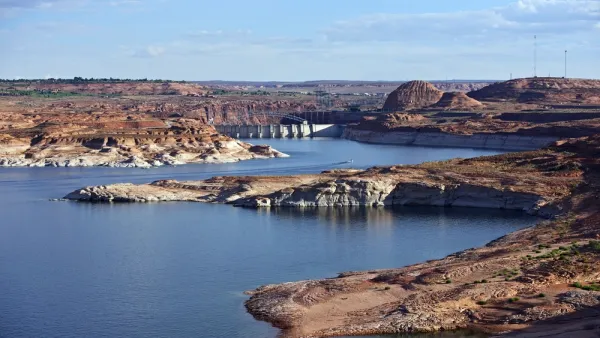
New Drought Contingencies Triggered for Upper Colorado River States
The latest Bureau of Reclamation report on water levels in Lake Powell and Lake Mead trigger new drought contingencies in Colorado, New Mexico, Utah, and Wyoming.
Drought Takes Hold of the American West
The megadrought continues, with contingency plans differing by location.

The state-sanctioned urbicide of Austin
People don’t kill cities. Freeways do.

US to reduce Colorado River water deliveries to Mexico
A new Colorado Treaty amendment reduces Mexico’s Colorado River water allocation by 250,000 acre feet.

New Jersey’s second-largest city bans standalone data centers
Jersey City will continue to allow co-location facilities, such as those meant for research institutions that store their own data.

Amtrak not solely to blame for New Jersey commuter rail's unreliability, report finds
A new study from the Garden State Initiative found that NJ Transit’s budget grew 20% across a 4 year period, but reliability declined significantly over the same period.

EPA erases limits on planet-warming pollution from power plants
Under Monday’s plan, power plants would still have some limits on how much mercury, arsenic and other contaminants they can emit.

Phoenix announces new on-demand transit service, more frequent RAPID buses
Both new services will launch in October, and are part of Phoenix's Project Effective Access Solutions for Easing Congestion.

FREE Course: Walkable City 1: Why Walkability?
After describing his path towards focusing on walkability as the essence of good planning, Jeff Speck marches through his five principal reasons for making more walkable places.
Reinventing Malls: Planning Alchemy—Turning Gray Fields Into Gold
The course focuses on the opportunities and imperatives that shape reinvention of mall sites.

Eagle County Government
Harvard University Graduate School of Design
Nashville Planning Department
The Architects Foundation
University of Cincinnati Online
The Pocatello Development Authority
The Urban Renewal Agency of the City of Pocatello
Journal of the American Planning Association