The Colorado city will make public transit free during the month of August to boost ridership and reduce emissions.


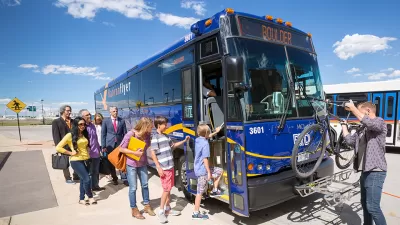
Last week, the City of Boulder and the Regional Transportation District (RTD) announced Zero Fare for Better Air, “a collaborative, statewide initiative designed to reduce ground-level ozone by increasing use of transit,” according to a press release from the city.
“Through a partnership with the Colorado Energy Office, made possible by Colorado Senate Bill 22-180, RTD will offer zero fares on all services during the month of August. The City of Boulder is also partnering with Via Mobility Services to provide zero-fare service on the local Boulder HOP bus route.” The one-month program aims to encourage more Boulder residents to try local public transportation options. In addition to eliminating up to 20 pounds of daily carbon dioxide emissions by switching to public transit, “A household can save nearly $10,000 by taking public transportation and living with one less car.”
“The city’s 2019 Transportation Master Plan (TMP) recommends zero fare for local and regional transit services as a strategy to enhance equity, promote access to opportunity, and reduce greenhouse gas emissions through modal shift and increased transit ridership.”
FULL STORY: City of Boulder joins RTD for Zero Fare for Better Air in August

Free Transit, But at What Cost?
Opinion: The movement toward fare-free transit might have more to do with optics and politics than planning.
Connecticut Extends Free Bus Fares
Local leaders applaud the move, but are calling on the state to keep fares free permanently.
Major Redesign Planned for Denver-Area Bus System
The Regional Transportation District will make significant changes to bus frequency and routes in an effort to make transit accessible to more Colorado residents.

The state-sanctioned urbicide of Austin
People don’t kill cities. Freeways do.

US to reduce Colorado River water deliveries to Mexico
A new Colorado Treaty amendment reduces Mexico’s Colorado River water allocation by 250,000 acre feet.

New Jersey’s second-largest city bans standalone data centers
Jersey City will continue to allow co-location facilities, such as those meant for research institutions that store their own data.

Amtrak not solely to blame for New Jersey commuter rail's unreliability, report finds
A new study from the Garden State Initiative found that NJ Transit’s budget grew 20% across a 4 year period, but reliability declined significantly over the same period.

EPA erases limits on planet-warming pollution from power plants
Under Monday’s plan, power plants would still have some limits on how much mercury, arsenic and other contaminants they can emit.

Phoenix announces new on-demand transit service, more frequent RAPID buses
Both new services will launch in October, and are part of Phoenix's Project Effective Access Solutions for Easing Congestion.

FREE Course: Walkable City 1: Why Walkability?
After describing his path towards focusing on walkability as the essence of good planning, Jeff Speck marches through his five principal reasons for making more walkable places.
Reinventing Malls: Planning Alchemy—Turning Gray Fields Into Gold
The course focuses on the opportunities and imperatives that shape reinvention of mall sites.

Eagle County Government
Harvard University Graduate School of Design
Nashville Planning Department
The Architects Foundation
University of Cincinnati Online
The Pocatello Development Authority
The Urban Renewal Agency of the City of Pocatello
Journal of the American Planning Association