PBOT will continue two highly successful COVID-era programs that allowed businesses and community groups to repurpose public spaces for pedestrian-oriented uses and engage with customers in safe, accessible outdoor settings.


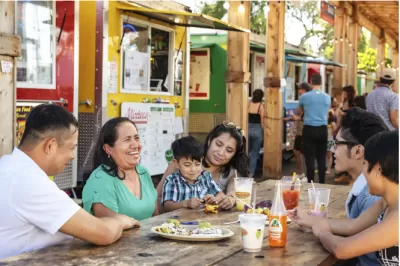
A news release from the Portland Bureau of Transportation (PBOT) highlights Transportation Commissioner Jo Ann Hardesty's announcement that "two programs that helped businesses and community groups use street space for restaurants and public gatherings will be continued this summer, and could become permanent with City Council approval in the upcoming city budget." The decision comes after an outpouring of positive feedback from businesses and residents.
"The free Healthy Businesses permits that were set to expire June 30 will be extended at no charge through Aug. 31, to allow more time for the city and businesses to transition to the next phase of the program," with the future of the program contingent on funding from the 2022-2023 budget.
The Portland Public Street Plazas program is seeking applications for five to 10 plazas to be built this summer. "Continuation beyond this summer is also contingent on the budget City Council sets in the coming months." The Bureau has requested $8 million from the city to continue both programs.
During 2022, PBOT will work to reevaluate design standards and inspect existing facilities to ensure they are brought into compliance with city regulations. According to PBOT, "To stabilize neighborhood businesses, new design and operating regulations will go into effect gradually over time. These new rules ensure access for people with disabilities, emergency response, public transit operations, and loading zones."

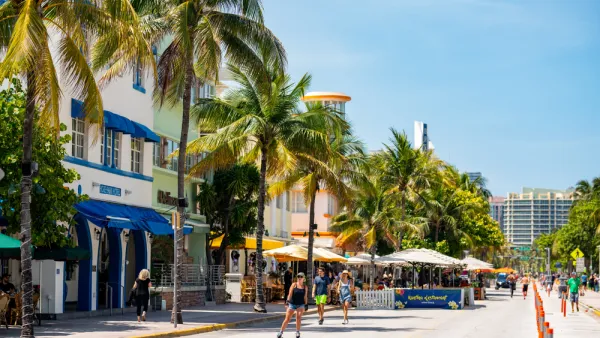
Miami Beach to Reopen Ocean Drive to Cars
The famous cruising strip was off-limits to cars during the pandemic. Now, the city is letting vehicles return with some pedestrian-oriented compromises.
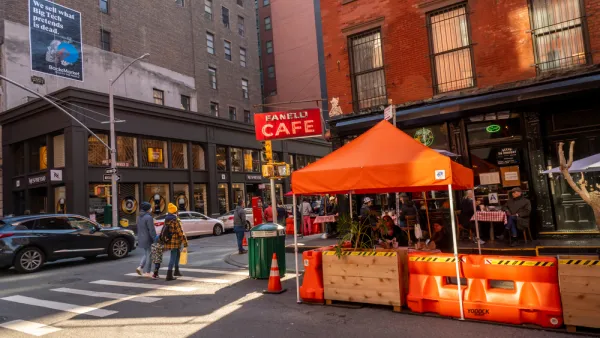
Opinion: Keep Outdoor Dining Without Thwarting Creativity
While New York City's effort to make its outdoor dining program permanent is a welcome reimagining of public space, some worry that regulations will reduce design diversity and increase costs for small restauranteurs.

San Diego Approves Permanent Outdoor Dining
The city's new regulations pave the way for making the pandemic experiment a permanent fixture.

The state-sanctioned urbicide of Austin
People don’t kill cities. Freeways do.

US to reduce Colorado River water deliveries to Mexico
A new Colorado Treaty amendment reduces Mexico’s Colorado River water allocation by 250,000 acre feet.

New Jersey’s second-largest city bans standalone data centers
Jersey City will continue to allow co-location facilities, such as those meant for research institutions that store their own data.

Amtrak not solely to blame for New Jersey commuter rail's unreliability, report finds
A new study from the Garden State Initiative found that NJ Transit’s budget grew 20% across a 4 year period, but reliability declined significantly over the same period.

EPA erases limits on planet-warming pollution from power plants
Under Monday’s plan, power plants would still have some limits on how much mercury, arsenic and other contaminants they can emit.

Phoenix announces new on-demand transit service, more frequent RAPID buses
Both new services will launch in October, and are part of Phoenix's Project Effective Access Solutions for Easing Congestion.

FREE Course: Walkable City 1: Why Walkability?
After describing his path towards focusing on walkability as the essence of good planning, Jeff Speck marches through his five principal reasons for making more walkable places.
Reinventing Malls: Planning Alchemy—Turning Gray Fields Into Gold
The course focuses on the opportunities and imperatives that shape reinvention of mall sites.

Eagle County Government
Harvard University Graduate School of Design
Nashville Planning Department
The Architects Foundation
University of Cincinnati Online
The Pocatello Development Authority
The Urban Renewal Agency of the City of Pocatello
Journal of the American Planning Association