Research shows that single-family zoning, frequently associated with 'exclusionary' housing policies, dominates Southern California's residential zoning.



According to research from a University of California, Berkeley study released on March 2, single-family zoning proves to be closely correlated with racial disparity. As Jeff Collins reports in the Press-Enterprise, "Three-quarters of Southern California’s neighborhoods are zoned exclusively for detached, single-family homes, contributing to racial segregation and limiting minority access to better schools and resources." Low-density zoning tends to "exclude lower-income people and people of color," writes Collins.
According to the report's authors, "What this means is that apartments, condos and other housing options are simply impossible to build … and the consequences are profound." The article details several Southern California cities that could increase their density. Collins goes on to note that "In general, zoning is used to regulate development to ensure compatible land use, as spelled out in a city’s master plan. But scholars have argued that exclusionary single-family zoning had sinister origins in the early 20th century, fostering racial segregation without mentioning race." Some cities, like Chino Hills, are fighting back against recommendations to raise their density, citing unique topography and fire hazards.
Single-family zoning has been a hot topic in recent years as states and cities work to undo the damage caused by exclusionary zoning and create incentives for infill development and increased density.
Read the full story: 78% of Southern California neighborhoods don’t allow apartments, study finds


LA delays state housing mandate with 'low-rise ordinance'
The new ordinance allows the city to delay implementing SB 79, a state law requiring more density near transit.

San Diego wants to limit upzoning law to just 16% of transit-adjacent parcels
The city's planning director says some areas are unfit for immediate upzoning due to a lack of resources or hazards such as wildfire risk.
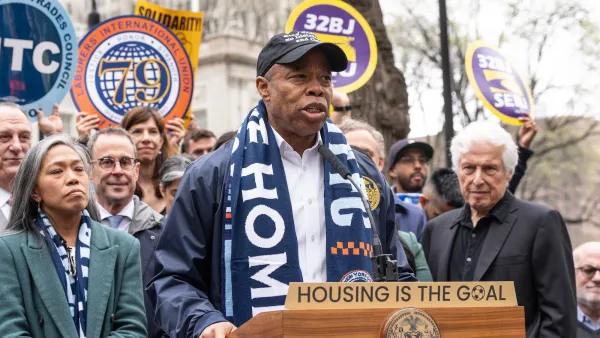
What Actually Got Built Under Eric Adams’ ‘Pro-Housing’ Administration
The outgoing mayor claims credit for hundreds of thousands of new homes. The truth is more complicated.

Planetizen Federal Action Tracker
A weekly monitor of how Trump’s orders and actions are impacting planners and planning in America.

Amtrak, CN end decades-long dispute with eight-year agreement
The new operating agreement establishes an updated framework for the companies to work together, including processes to resolve disputes.

Colorado’s Largest Data Center Could Rise Next to Homes — Without a Public Hearing
The proposed campus would consume 11 times the power of Denver International Airport; as it has across the country, opposition mounts.

'This is going to be painful:’ Virginia stares down $1.7 billion funding gap for highway maintenance
The state may address the deficit by shifting $290 million from its construction budget to maintenance projects.

Judges permit Denver to divert 77,000 acre feet from the Colorado River for reservoir expansion
Overuse and climate change have caused the Colorado River’s water levels to plummet.

Amtrak, CN end decades-long dispute with eight-year agreement
The new operating agreement establishes an updated framework for the companies to work together, including processes to resolve disputes.

FREE Course: Walkable City 1: Why Walkability?
After describing his path towards focusing on walkability as the essence of good planning, Jeff Speck marches through his five principal reasons for making more walkable places.
Reinventing Malls: Planning Alchemy—Turning Gray Fields Into Gold
The course focuses on the opportunities and imperatives that shape reinvention of mall sites.

KFH Group Inc.
Greater Baltimore Committee
Eagle County Government
The Architects Foundation
University of Cincinnati Online
The Pocatello Development Authority
The Urban Renewal Agency of the City of Pocatello