The Mount Laurel Doctrine tasks each city and town with creating enough affordable housing to meet their needs, but half a century after its passage, the law still faces opposition in some parts of the state.



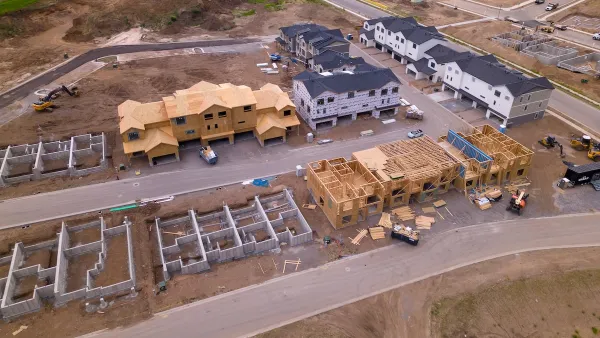
New Jersey’s Mount Laurel Doctrine, enacted 50 years ago, mandates that each municipality accommodate enough affordable housing to meet local needs. But as Michael L. Diamond explains in an article for Asbury Park Press, the law, which has led to the creation of 400,000 new housing units, still faces significant opposition from some local leaders. Some suburban towns argue that the quotas set by the state are unfair or arbitrary.
Governor Phil Murphy blamed this pushback for the insufficient housing supply, saying at an event commemorating the doctrine, “In New Jersey, we have wrestled with how to apply the principles of the Mount Laurel doctrine in practice, and along the way we've seen a slew of legal challenges that have sought to delay the development of new affordable housing units in the communities where they are needed most.”
The Mount Laurel Doctrine is the result of a 1970s lawsuit filed by Black residents against the city that made its way to the U.S Supreme Court, where the court ruled that “not only did Mount Laurel have an obligation to provide affordable housing, but also so did every other municipality.”
Read the full story: NJ built 400K affordable homes since Mount Laurel decision 50 years ago; it's not enough

What Actually Got Built Under Eric Adams’ ‘Pro-Housing’ Administration
The outgoing mayor claims credit for hundreds of thousands of new homes. The truth is more complicated.

San Francisco Mayor’s ‘Family Zoning’ Plan Faces Pushback, Displacement Concerns
Newly proposed legislation aims to protect long-term tenants from displacement caused by Mayor Lurie’s proposed zoning reform plan, which would allow for more housing construction in parts of the city.
‘Montana Miracle:’ The State Actually Succeeding at Housing Reform
A series of ambitious zoning reforms is having a significant impact on the state’s housing supply.

Planetizen Federal Action Tracker
A weekly monitor of how Trump’s orders and actions are impacting planners and planning in America.

California plans to bury El Niño’s downpour
If the state plays its cards right, it may be able to store a billion acre-feet of El Niño’s water in aquifers.

Desperate measures: Advocates weigh draining Lake Powell to fill Colorado River
Draining the reservoir could reduce evaporation losses by a couple hundred thousand acre-feet.

Mamdani’s pied-à-terre tax survives legal challenge
A panel of judges found that the plaintiffs failed to demonstrate injury as a result of New York City's implementation of the tax.

Eastern Nebraska is running out of electricity
Data centers and electrification are straining eastern Nebraska’s grid, throttling economic development.

Seattle passes record-breaking transit services expansion
Proposition 1 will double the city’s transit tax to add 95,000 more bus trips and preserve 180,000 bus trips annually.

FREE Course: Walkable City 1: Why Walkability?
After describing his path towards focusing on walkability as the essence of good planning, Jeff Speck marches through his five principal reasons for making more walkable places.
Reinventing Malls: Planning Alchemy—Turning Gray Fields Into Gold
The course focuses on the opportunities and imperatives that shape reinvention of mall sites.

City of Rosemead
Rutgers University, Edward J. Bloustein School of Planning and Public Policy
One Hundred Miles
University of Michigan School for Environment and Sustainability (SEAS)
Hunter College, City University of New York (CUNY)
The Architects Foundation
City of Cambridge
Montrose County
The Pocatello Development Authority