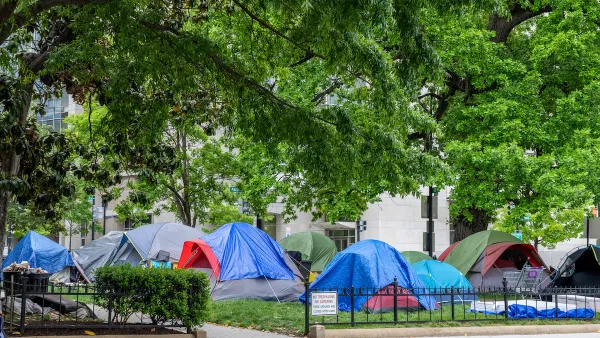
Housing voucher recipients face a gauntlet of challenges when trying to find housing. Nonprofits are doing their best to streamline the process.



Ethan Ward describes the challenges plaguing the federal Section 8 housing voucher program, which provides rental assistance to low-income people but fails to reach many of those who need it most. According to Mark Vestal, co-author of "Making of a Crisis: The History of Homelessness in L.A.," a report from the UCLA Luskin Center for History and Policy, "About 50% of people who get vouchers can't find housing. Landlords can discriminate against voucher holders and they have complete discretion."
As neighborhoods gentrify, Vestal says, voucher recipients find more and more limited housing options. After experiencing difficulties using vouchers for various reasons, one Los Angeles nonprofit, the Homeless Outreach Program Integrated Care System (HOPICS), decided to try a new approach: because landlords often express concerns about potential damage to units rented by voucher recipients, HOPICS has started negotiating with landlords to manage buildings themselves—including maintenance and repairs. HOPICS director Veronica Lewis says she hopes the experiment can provide a scalable model for other housing nonprofits and calls for a 'damage mitigation fund' to aid organizations like hers in taking similar actions.
"Lewis said a shift in the way things are done is necessary to get people housed faster. Vestal said unhoused people are at least elevated in the eyes of those who have the power as being full fledged political subjects who have ideas about how they want to live and who they want to live," writes Ward.
FULL STORY: A Voucher Program May Help Homelessness... But Some Barriers Get In The Way


Opinion: Los Angeles Needs More Housing, Fast
The shortage of housing at all price points in the region is the main driver of high costs and the growing homelessness crisis.
Strategies for Preventing and Ending Homelessness
A new report recommends a comprehensive, nationwide affordable housing plan as the ‘single most effective’ method of ending homelessness.

Opinion: Unhoused People Need Housing, Not Law Enforcement
The sharp increase in the unhoused population calls for urgent action, not criminalization.

Planetizen Federal Action Tracker
A weekly monitor of how Trump’s orders and actions are impacting planners and planning in America.

The state-sanctioned urbicide of Austin
People don’t kill cities. Freeways do.

US to reduce Colorado River water deliveries to Mexico
A new Colorado Treaty amendment reduces Mexico’s Colorado River water allocation by 250,000 acre feet.

Mamdani overhauls NYC's Vision Zero plan with 100 new policy goals
The overhaul aims to reduce traffic deaths and make streets safer for pedestrians, cyclists and drivers through lower speed limits, new safety infrastructure and more.

Amtrak not solely to blame for New Jersey commuter rail's unreliability, report finds
A new study from the Garden State Initiative found that NJ Transit’s budget grew 20% across a 4 year period, but reliability declined significantly over the same period.

EPA erases limits on planet-warming pollution from power plants
Under Monday’s plan, power plants would still have some limits on how much mercury, arsenic and other contaminants they can emit.

FREE Course: Walkable City 1: Why Walkability?
After describing his path towards focusing on walkability as the essence of good planning, Jeff Speck marches through his five principal reasons for making more walkable places.
Reinventing Malls: Planning Alchemy—Turning Gray Fields Into Gold
The course focuses on the opportunities and imperatives that shape reinvention of mall sites.

Eagle County Government
Harvard University Graduate School of Design
Nashville Planning Department
The Architects Foundation
University of Cincinnati Online
The Pocatello Development Authority
The Urban Renewal Agency of the City of Pocatello
Journal of the American Planning Association