Shifting commute patterns and the popularity of remote work could pose an existential threat to the New York City region's commuter rail services.


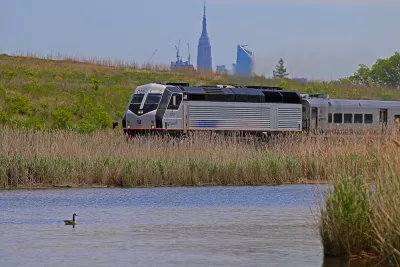
As reported by Matthew Haag and Patrick McGeehan, New York City's commuter rail services are continuing to experience drastically reduced ridership as the five-day office workweek seems increasingly obsolete. "In 2019, the regional transit agencies collectively carried more than 500 million passengers across the New York area, but ridership in 2021 declined by more than half of that prepandemic level." According to the MTA, the agency collected only $49 million in fares in 2021, down from $346 million in 2019.
The authors note that sales of monthly passes on commuter rail are down by 75 percent, leading to a dramatic drop in revenue despite optimistic projections from transit agencies. "Even as transit officials insist that the commuter railroads will start bouncing back in notable numbers this year, the agency is also acknowledging that the pandemic is more and more likely to lead to permanent changes in the region’s commuting pattern."
The agency has approved discounted passes to incentivize riders, but many former commuters show little interest in returning to hours-long commutes and passes that cost upward of $300. The article quotes Phil Pescatore, chief ethics officer at Guardian Life Insurance Company of America, who used to commute into the city from New Jersey. "'It’s been found time, and I have repurposed that time,' Mr. Pescatore said. 'I do things that I hadn’t had a chance to do: a bit more exercise in the morning, and the ability to think and plan a little bit more.'"
FULL STORY: How Remote Work Is Devastating New York City’s Commuter Rails

How Americans Spend Former Commute Time
Unsurprisingly, American workers whose commutes have been reduced or eliminated by new remote work arrangements are spending more time on rest, leisure, and childcare activities.
Some Commute Times Worsening Despite Remote Work Trends
The unpredictability of constantly changing commuting trends has some workers seeing much longer commute times as transportation agencies work to adjust to new travel patterns.

Census Bureau: Remote Work Tripled Between 2019 and 2021
The percentage of Americans working primarily from home tripled to over 27 million people during the pandemic. Will the popularity of remote work last?

The state-sanctioned urbicide of Austin
People don’t kill cities. Freeways do.

US to reduce Colorado River water deliveries to Mexico
A new Colorado Treaty amendment reduces Mexico’s Colorado River water allocation by 250,000 acre feet.

New Jersey’s second-largest city bans standalone data centers
Jersey City will continue to allow co-location facilities, such as those meant for research institutions that store their own data.

Amtrak not solely to blame for New Jersey commuter rail's unreliability, report finds
A new study from the Garden State Initiative found that NJ Transit’s budget grew 20% across a 4 year period, but reliability declined significantly over the same period.

EPA erases limits on planet-warming pollution from power plants
Under Monday’s plan, power plants would still have some limits on how much mercury, arsenic and other contaminants they can emit.

Phoenix announces new on-demand transit service, more frequent RAPID buses
Both new services will launch in October, and are part of Phoenix's Project Effective Access Solutions for Easing Congestion.

FREE Course: Walkable City 1: Why Walkability?
After describing his path towards focusing on walkability as the essence of good planning, Jeff Speck marches through his five principal reasons for making more walkable places.
Reinventing Malls: Planning Alchemy—Turning Gray Fields Into Gold
The course focuses on the opportunities and imperatives that shape reinvention of mall sites.

Eagle County Government
Harvard University Graduate School of Design
Nashville Planning Department
The Architects Foundation
University of Cincinnati Online
The Pocatello Development Authority
The Urban Renewal Agency of the City of Pocatello
Journal of the American Planning Association