Demonstrations at the Consumer Electronics Show in Las Vegas highlight the failures of Tesla's autonomous vehicles and the Boring Company's tunnels.


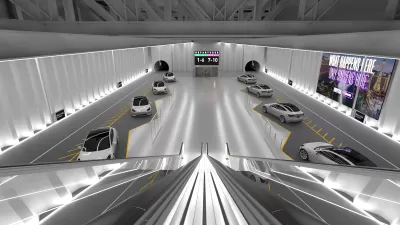
According to an article by Alissa Walker, the failures of two highly anticipated Elon Musk projects were clearly articulated at the Consumer Electronics Show in Las Vegas, where Tesla's autonomous cars and Musk's Boring Company tunnels were both on display.
After the Las Vegas tourism agency paid Musk's Boring Company $50 million to build tunnels under the city's convention center, video posted on social media showed cars stuck in traffic inside the tunnel, described horrifyingly by Walker as "the world's longest MRI machine." The tunnel, which was supposed to turn a 20-minute walk into a one-minute ride, was designed—and contractually obligated—to shuttle 4,000 people per hour during major trade shows at the convention center. To date, the tunnel moves roughly 1,300 people per hour. Walker notes that this is "about the capacity of standard (and, often, autonomous) people-movers all over Vegas."
Meanwhile, as part of a presentation about LIDAR technology, Tesla's autonomous cars consistently failed to identify a child-sized dummy, hitting the "child" every time. The presentation was demonstrating pedestrian detection systems which industry safety experts agree should be robust and redundant on automated vehicles.
Last month, Tesla was forced to recall almost half a million of its Model 3 and Model S cars after the National Highway Traffic Safety Administration (NHTSA) identified problems with the rearview camera and front hood, which could open without warning while driving. The agency is also investigating Tesla's autonomous driving features and other safety concerns.
FULL STORY: Two of Elon Musk's Terrible Ideas Both Flopped in Las Vegas


Tesla’s Self-Driving Still Not Working in Las Vegas Tunnels
The Boring Company had previously said it was working with Tesla to use its self-driving system in its tunnels below Las Vegas to save costs on drivers, but two years later, there is no clear timeline for “full autonomy.”
Las Vegas Doubles Down on Elon Musk and the Boring Co.
The Clark County Commission wants more Teslas in more tunnels.
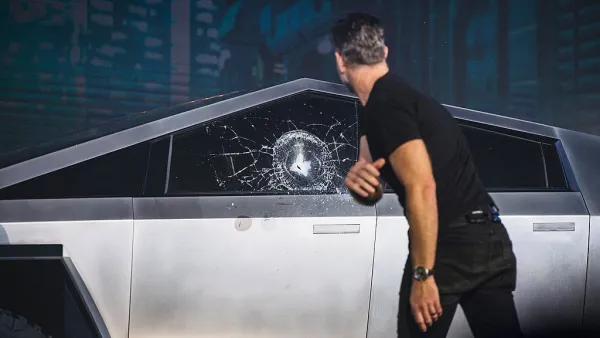
Opinion: Stop Trusting Elon Musk—on Tunnels, on Teslas, on Everything
Musk has leveraged social media intrigue and a hot streak on the market to become the standard bearer for autonomous vehicle technology. Trust Tesla at public peril, argues James Brasuell in this opinion piece.

The state-sanctioned urbicide of Austin
People don’t kill cities. Freeways do.

US to reduce Colorado River water deliveries to Mexico
A new Colorado Treaty amendment reduces Mexico’s Colorado River water allocation by 250,000 acre feet.

New Jersey’s second-largest city bans standalone data centers
Jersey City will continue to allow co-location facilities, such as those meant for research institutions that store their own data.

Amtrak not solely to blame for New Jersey commuter rail's unreliability, report finds
A new study from the Garden State Initiative found that NJ Transit’s budget grew 20% across a 4 year period, but reliability declined significantly over the same period.

EPA erases limits on planet-warming pollution from power plants
Under Monday’s plan, power plants would still have some limits on how much mercury, arsenic and other contaminants they can emit.

Phoenix announces new on-demand transit service, more frequent RAPID buses
Both new services will launch in October, and are part of Phoenix's Project Effective Access Solutions for Easing Congestion.

FREE Course: Walkable City 1: Why Walkability?
After describing his path towards focusing on walkability as the essence of good planning, Jeff Speck marches through his five principal reasons for making more walkable places.
Reinventing Malls: Planning Alchemy—Turning Gray Fields Into Gold
The course focuses on the opportunities and imperatives that shape reinvention of mall sites.

Eagle County Government
Harvard University Graduate School of Design
Nashville Planning Department
The Architects Foundation
University of Cincinnati Online
The Pocatello Development Authority
The Urban Renewal Agency of the City of Pocatello
Journal of the American Planning Association