The Financial District and Seaport Climate Resilience Master Plan will extend the shoreline in Lower Manhattan by up to 200 feet.



The Financial District and Seaport Climate Resilience Master Plan, a blueprint for comprehensive flood defense infrastructure to protect Lower Manhattan from the threats of climate change, was released to the public on December 29, 2021.
A press release from (now former) Mayor de Blasio, the New York City Economic Development Corporation (NYCEDC), and the Mayor's Office of Climate Resiliency (MOCR) announced the release of the climate resilience plan.
The climate resilience plan reimagines the shoreline of Lower Manhattan by creating a "multilevel waterfront that extends the shoreline of the East River by up to 200 feet from its existing location," according to the press release. The reimagined waterfront is intended to withstand severe coastal storms and rising sea levels while also creating new open space for public use when waters are calm. "The upper level will be elevated by about 15 to 18 feet to protect against severe storms like Sandy, while doubling as public open spaces with sweeping views of the city and harbor. The lower level will be a continuous waterfront esplanade, raised three to five feet to protect against sea level rise while connecting New Yorkers to the water's edge," adds the press release.
The plan comes with a projected price tag of somewhere between $5 billion and $7 billion.
News coverage of the new climate resilience master plan is available from New York City Patch and a paywalled article at Crain's New York Business.
FULL STORY: De Blasio Administration Releases Climate Resilience Plan for Financial District and Seaport

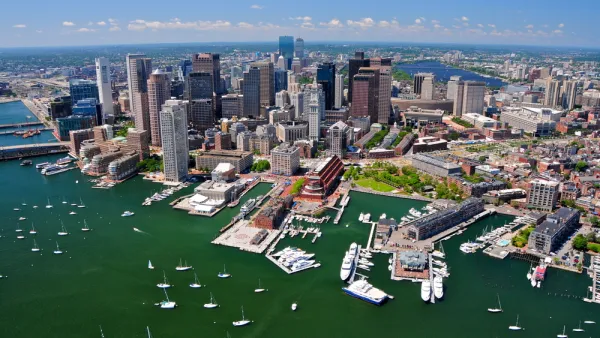
Acting Mayor Pulls Boston's Downtown Harbor Plan
Intrigue continues for waterfront development plans in Boston and nearby cities.
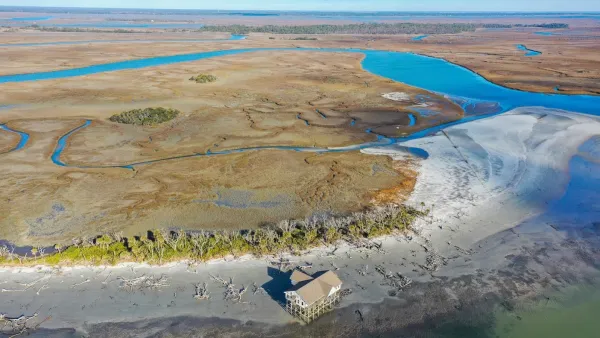
An Open Space Plan for Cultural Landscapes, Resilience, and Growth in the Coastal Southeast
The Beaufort County Greenprint Plan, completed in 2020, offers an innovative model of open space planning integrated within a larger planning framework.
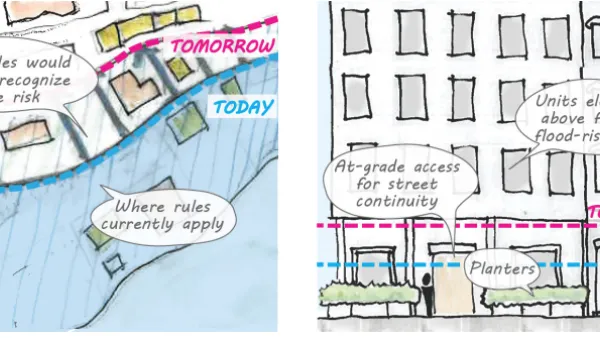
'Zoning for Coastal Flood Resiliency' Wins Planning Commission Approval in NYC
Emergency responses to Hurricane Sandy have turned into long-term lessons in New York City, as the nation's largest city crafts a response to sea-level rise and extreme weather by making changes to the zoning code of coastal areas.

The state-sanctioned urbicide of Austin
People don’t kill cities. Freeways do.

US to reduce Colorado River water deliveries to Mexico
A new Colorado Treaty amendment reduces Mexico’s Colorado River water allocation by 250,000 acre feet.

New Jersey’s second-largest city bans standalone data centers
Jersey City will continue to allow co-location facilities, such as those meant for research institutions that store their own data.

Amtrak not solely to blame for New Jersey commuter rail's unreliability, report finds
A new study from the Garden State Initiative found that NJ Transit’s budget grew 20% across a 4 year period, but reliability declined significantly over the same period.

EPA erases limits on planet-warming pollution from power plants
Under Monday’s plan, power plants would still have some limits on how much mercury, arsenic and other contaminants they can emit.

Phoenix announces new on-demand transit service, more frequent RAPID buses
Both new services will launch in October, and are part of Phoenix's Project Effective Access Solutions for Easing Congestion.

FREE Course: Walkable City 1: Why Walkability?
After describing his path towards focusing on walkability as the essence of good planning, Jeff Speck marches through his five principal reasons for making more walkable places.
Reinventing Malls: Planning Alchemy—Turning Gray Fields Into Gold
The course focuses on the opportunities and imperatives that shape reinvention of mall sites.

Eagle County Government
Harvard University Graduate School of Design
Nashville Planning Department
The Architects Foundation
University of Cincinnati Online
The Pocatello Development Authority
The Urban Renewal Agency of the City of Pocatello
Journal of the American Planning Association