The foreclosure risk facing a pair of high-profile office buildings highlight the debt difficulties facing the office sector as it deals with the fallout of the pandemic. The trend could be on the verge of picking up steam.


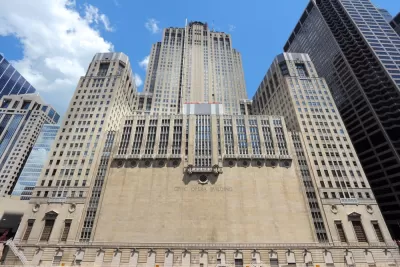
"Some office properties that've faced sharp occupancy drops since the Covid-19 pandemic are face warnings of possible foreclosure proceedings," reports Ashley Fahey.
Fahey is sharing the results of a Business Journals analysis of bond documents for office properties in the commercial mortgage-backed securities market, finding two high-profile towers (one in Chicago and one in Dallas) "marked as delinquent on debt payments that also are being pushed toward potential foreclosure proceedings by lenders and loan servicers."
The article provides details on the two buildings, the Civic Opera Building in Chicago (a paywalled article published by Crain's Chicago Business reports on a foreclosure lawsuit filed last week for that building) and the Harwood Center in Dallas. The former's occupancy rate fell from 92 percent before the pandemic to 71 percent as of March 2021. The latter's fell from 90 percent to 70 percent.
The aggregate of the data analyzed by the Business Journals finds signs of more general distress:
- "Nationally, 91 office properties or portfolios are in special servicing, with 44% of them marked as delinquent."
- Houston has the most office properties in special services, with seven.
- "Although fewer than 100 office properties or portfolios are in special servicing, there are 782 office properties or portfolios across the U.S. on loan-servicer watchlists, which highlight concerns over a borrowers' abilities to stay current on a existing property debts."
More findings are included in the article below.
FULL STORY: Analysis: High-profile office towers face foreclosure warnings as occupancy slips, debts come due

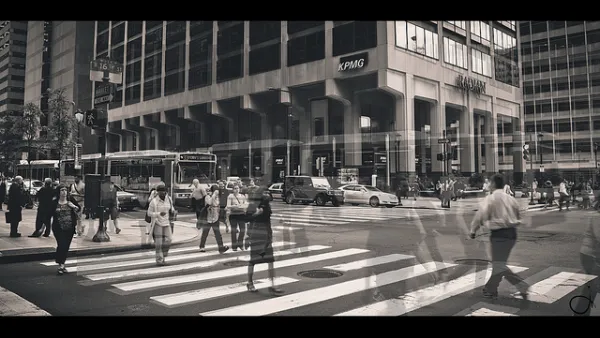
The Future of Downtowns Still Hangs in the Balance
Center City in Philadelphia offers a case study for one of the largest and potentially most consequential contingencies of the pandemic: What happens to downtowns is most workers never come back to the office?
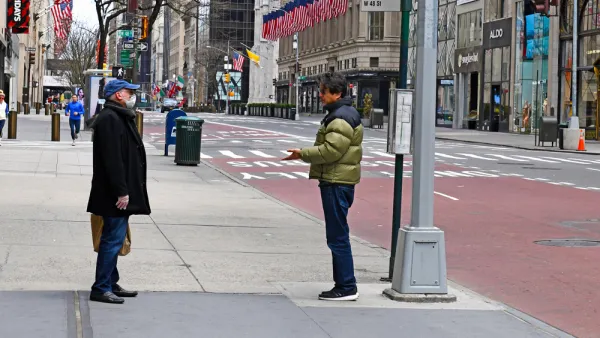
Friday Eye Candy: Covid-19, Then and Now
The New York Times compared images from readers portraying similar scenes in 2020 and 2022.

D.C., San Francisco Lead Pandemic Work From Home Trend
Remote work increased threefold during the pandemic, but the numbers vary significantly from city to city and region to region. Almost half of D.C.-area employees, for example, worked from home in 2021, according to American Community Survey data.

The state-sanctioned urbicide of Austin
People don’t kill cities. Freeways do.

US to reduce Colorado River water deliveries to Mexico
A new Colorado Treaty amendment reduces Mexico’s Colorado River water allocation by 250,000 acre feet.

New Jersey’s second-largest city bans standalone data centers
Jersey City will continue to allow co-location facilities, such as those meant for research institutions that store their own data.

Amtrak not solely to blame for New Jersey commuter rail's unreliability, report finds
A new study from the Garden State Initiative found that NJ Transit’s budget grew 20% across a 4 year period, but reliability declined significantly over the same period.

EPA erases limits on planet-warming pollution from power plants
Under Monday’s plan, power plants would still have some limits on how much mercury, arsenic and other contaminants they can emit.

Phoenix announces new on-demand transit service, more frequent RAPID buses
Both new services will launch in October, and are part of Phoenix's Project Effective Access Solutions for Easing Congestion.

FREE Course: Walkable City 1: Why Walkability?
After describing his path towards focusing on walkability as the essence of good planning, Jeff Speck marches through his five principal reasons for making more walkable places.
Reinventing Malls: Planning Alchemy—Turning Gray Fields Into Gold
The course focuses on the opportunities and imperatives that shape reinvention of mall sites.

Eagle County Government
Harvard University Graduate School of Design
Nashville Planning Department
The Architects Foundation
University of Cincinnati Online
The Pocatello Development Authority
The Urban Renewal Agency of the City of Pocatello
Journal of the American Planning Association