In December 2019, the Downtown Brooklyn Public Realm Vision set ambitious goals for removing cars from one of New York's central business districts. Then came the pandemic and new tests for those ambitions.


Stakeholders in Downtown Brooklyn are building on a 2019 master plan that ranks as one of the most ambitious visions for car-free urbanism in the country.
The Downtown Brooklyn Partnership unveiled the Downtown Brooklyn Public Realm Vision in 2019, inspired in part by recent street redesigns in the city, like the pedestrianization of Times Square and the 14th Street Busway (Benjamin Schneider broke the news of the Public Realm Vision in December 2019).
A new article by John Schneider updates the progress toward achieving the master plan's ambitious vision—which includes a neighborhood network of Dutch-style shared streets, busways, protected bike lanes, and improvements to green spaces.
"It was a pedestrian-centric rebuke of the Robert Moses-era planning that dominates much of the borough, where cars flood wide streets en route to the Brooklyn and Manhattan Bridges," according to Surico.
With the pandemic generating unanticipated support for car-free reforms, the Downtown Brooklyn Partnership is hoping to build on that momentum by releasing the Downtown Brooklyn Public Realm Action Plan, a Covid-era update to the original master plan released earlier this month.
"The plan doubles down on the 2019 vision’s calls for pedestrianization, while picking up institutional support and a handful of tangible achievements since then. Not to mention a new streetscape paradigm: This is a city where pandemic-era curbside dining and 'Open Streets' are now permanent fixtures," writes Surico.
As detailed in the source article, linked below, the Downtown Brooklyn is far from alone in its efforts to pedestrianize New York City.
FULL STORY: Downtown Brooklyn’s Greener, Car-Free Future Is Taking Root

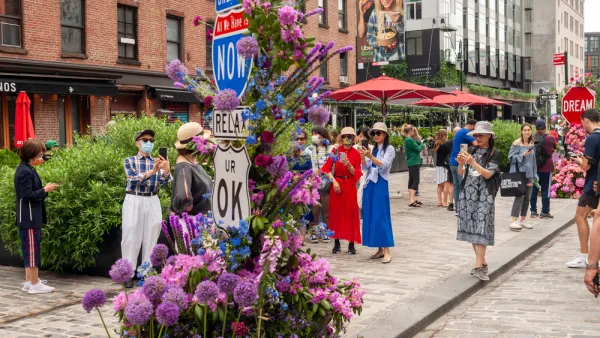
The Tide Has Turned Against Open Streets
Once a promising development for advocates pushing for a less car-centric future in cities, the open streets movement has ceded significant ground to cars since the height of the pandemic.
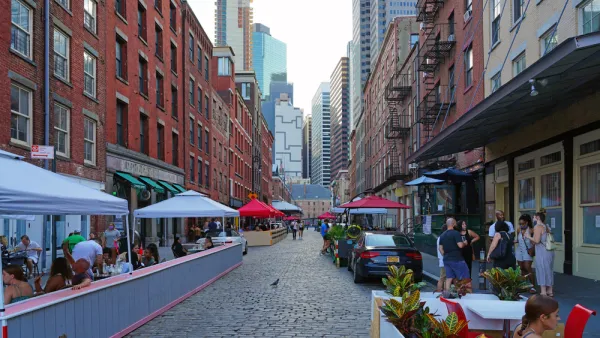
New Car Owners, Fewer Parking Spaces—Chickens Come to Roost in New York City
Many cities like New York have reallocated space formerly reserved for moving and storing cars to help restaurants and stores weather the pandemic, but as more residents rely on cars for the same reason, the dynamic threatens to boil over.
New York Outdoor Dining, Open Streets Programs Now Permanent
New York City will now be measurably less car-centric for the indefinite future.

The state-sanctioned urbicide of Austin
People don’t kill cities. Freeways do.

US to reduce Colorado River water deliveries to Mexico
A new Colorado Treaty amendment reduces Mexico’s Colorado River water allocation by 250,000 acre feet.

New Jersey’s second-largest city bans standalone data centers
Jersey City will continue to allow co-location facilities, such as those meant for research institutions that store their own data.

Amtrak not solely to blame for New Jersey commuter rail's unreliability, report finds
A new study from the Garden State Initiative found that NJ Transit’s budget grew 20% across a 4 year period, but reliability declined significantly over the same period.

EPA erases limits on planet-warming pollution from power plants
Under Monday’s plan, power plants would still have some limits on how much mercury, arsenic and other contaminants they can emit.

Phoenix announces new on-demand transit service, more frequent RAPID buses
Both new services will launch in October, and are part of Phoenix's Project Effective Access Solutions for Easing Congestion.

FREE Course: Walkable City 1: Why Walkability?
After describing his path towards focusing on walkability as the essence of good planning, Jeff Speck marches through his five principal reasons for making more walkable places.
Reinventing Malls: Planning Alchemy—Turning Gray Fields Into Gold
The course focuses on the opportunities and imperatives that shape reinvention of mall sites.

Eagle County Government
Harvard University Graduate School of Design
Nashville Planning Department
The Architects Foundation
University of Cincinnati Online
The Pocatello Development Authority
The Urban Renewal Agency of the City of Pocatello
Journal of the American Planning Association