New Deal agencies did engage in discriminatory lending practices–but not quite in the way we think.


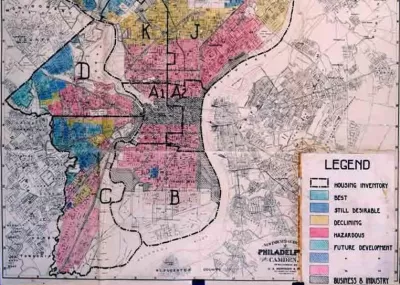
Redlining–the practice of denying mortgages in certain neighborhoods based on maps created by the Home Owners Loan Corporation (HOLC) in the 1930s–has long been associated with disinvestment in Black neighborhoods. But according to Jake Blumgart, new research "complicates our understanding" of the practice and shows that redlining "did not quite work in the way that it is popularly understood."
In the 1930s, HOLC "drew up color-coded maps that evaluated neighborhoods based on their presumed prospects, with those believed to have the worst outlooks drawn in red." Until now, historians have interpreted this as a root cause of discriminatory lending. "But new research shows that the maps very probably did not guide private lenders or the Federal Housing Administration (FHA), which clearly engaged in racist lending practices all on their own. The HOLC, however, actually loaned widely in Black neighborhoods and other red-shaded areas."
As Blumgart writes, "Fishback and his co-authors are not arguing that racist mortgage practices did not occur. But they are trying to disentangle the policy of the two New Deal-era mortgage institutions, one of which engaged in heavily anti-Black practices (the FHA) and the other of which did not (HOLC)." Based on a sample of 16,000 loans in three cities, the researchers "found that in all three cities the HOLC refinanced many loans in neighborhoods coded red, with no evidence of discrimination against Black homeowners. The FHA, on the other hand, did not insure mortgages in the neighborhoods where Black homeowners lived and chiefly targeted newly constructed homes, which almost exclusively catered to whites, and those in wealthier neighborhoods."
This yields important lessons for today's policymakers, who can shape an agency's practices through the language of their legislation. "[T]he FHA was created to encourage 'economically sound”' loans that mostly translated into new construction — especially in the suburbs — which at that time almost entirely went to white families." Meanwhile, HOLC's legislation "is written to center struggling homeowners and to bail them out of a macroeconomic crisis they did not create," leading to different practices from the two agencies.
Amy Hillier, a researcher whose work showed that HOLC did, in fact, lend "heavily" in "redlined" areas, concludes that the new research validates her findings. "[H]ousing discrimination can happen in very subtle ways that are at least as insidious as very dramatic red maps with lines on them."
FULL STORY: Redlining Didn’t Happen Quite the Way We Thought It Did

Rethinking Redlining
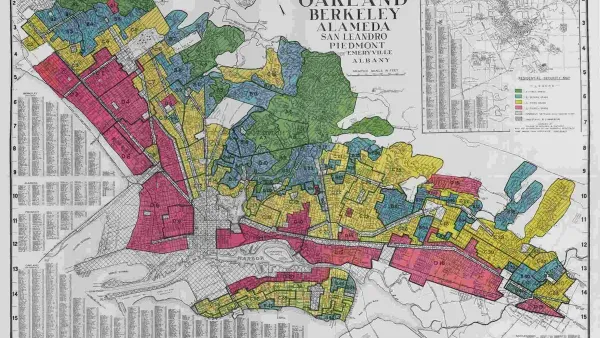
For decades we have blamed 100-year-old maps for the patterns of spatial racial inequity that persist in American cities today. An esteemed researcher says: we’ve got it all wrong.

HUD Announces New Loan Limits for Manufactured Housing
The new loan limits are expected to help more homebuyers access affordable housing options.

How South Phoenix's Legacy of Housing Discrimination Impacts Residents Today
Redlined for decades, south Phoenix is experiencing a resurgence that could push local residents even farther out as housing costs spike.

Planetizen Federal Action Tracker
A weekly monitor of how Trump’s orders and actions are impacting planners and planning in America.

The state-sanctioned urbicide of Austin
People don’t kill cities. Freeways do.

US to reduce Colorado River water deliveries to Mexico
A new Colorado Treaty amendment reduces Mexico’s Colorado River water allocation by 250,000 acre feet.

5 New England states march closer to 800 megawatt wind energy project
Securing federal approval for the project may be complicated under the Trump administration, which has historically been hostile towards domestic wind power.

Baltimore to break ground on $50 million Transit Priority Project
The project will bring faster bus trips, safer streets and better bike connections to Baltimore.

Airbnb launches $250 million 'last-dollar financing' housing accelerator, makes first investment in Austin
The company will put $6.4 million towards affordable housing development in Texas’ capital.

FREE Course: Walkable City 1: Why Walkability?
After describing his path towards focusing on walkability as the essence of good planning, Jeff Speck marches through his five principal reasons for making more walkable places.
Reinventing Malls: Planning Alchemy—Turning Gray Fields Into Gold
The course focuses on the opportunities and imperatives that shape reinvention of mall sites.

Eagle County Government
Harvard University Graduate School of Design
Nashville Planning Department
The Architects Foundation
University of Cincinnati Online
The Pocatello Development Authority
The Urban Renewal Agency of the City of Pocatello
Journal of the American Planning Association