Researchers at the University of New Mexico created a sidewalk design using materials that would reduce heat absorption and require fewer materials than traditional concrete sidewalks.


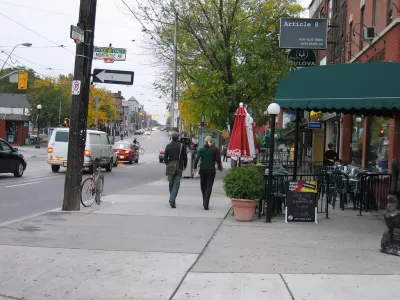
Traditional concrete sidewalks "absorb heat, occasionally buckling because of the pressure from heated expansion; and can even reflect heat, causing 'heat islands' in urban areas." Hope Muñoz and Rachel Whitt report on an innovation that could replace concrete with cooler, more environmentally friendly materials. Research students at the University of New Mexico have "designed a sidewalk built using recycled and less energy- and carbon-intensive materials," which is also much thinner than the average four-inch sidewalk.
After looking at historic sidewalk construction, researcher Patience Raby said "[i]t seems there was not good explanation for the use of standard concrete mixes in sidewalks or even for the fact that they’re usually four inches deep." According to a Federal Highway Administration report, "Atmospheric heat islands can affect communities by increasing summertime peak energy demand, electrical grid reliability, air conditioning costs, air pollution and GHG emissions, heat-related illness and death, and water quality." The new design reduces heat and the amount of materials needed for its construction. "The researchers fabricated three slabs to compare their thermal output, emissivity, and energy balance."
"In the future, the team would like to design 3D printed concrete slabs and those which are thin fiber reinforced with voids. These slabs would later be tested for heat storage potential."
FULL STORY: UNM researchers explore cool and renewable sidewalks

Cool Planning for a Hotter Future
Global warming increases the importance of designing buildings and communities that are comfortable, efficient, and safe in hot conditions.
Copenhagen is losing its cool
In a city long designed to maximize light during dark Scandinavian winters, climate change is forcing the Danish capital to rethink its relationship with the sun.
FTA Kills ‘Social Cost of Carbon’ in Transit Grant Criteria
The Capital Investments Grant program will no longer factor in the future impacts of carbon emissions.

Planetizen Federal Action Tracker
A weekly monitor of how Trump’s orders and actions are impacting planners and planning in America.

The state-sanctioned urbicide of Austin
People don’t kill cities. Freeways do.

US to reduce Colorado River water deliveries to Mexico
A new Colorado Treaty amendment reduces Mexico’s Colorado River water allocation by 250,000 acre feet.

5 New England states march closer to 800 megawatt wind energy project
Securing federal approval for the project may be complicated under the Trump administration, which has historically been hostile towards domestic wind power.

Baltimore to break ground on $50 million Transit Priority Project
The project will bring faster bus trips, safer streets and better bike connections to Baltimore.

Airbnb launches $250 million 'last-dollar financing' housing accelerator, makes first investment in Austin
The company will put $6.4 million towards affordable housing development in Texas’ capital.

FREE Course: Walkable City 1: Why Walkability?
After describing his path towards focusing on walkability as the essence of good planning, Jeff Speck marches through his five principal reasons for making more walkable places.
Reinventing Malls: Planning Alchemy—Turning Gray Fields Into Gold
The course focuses on the opportunities and imperatives that shape reinvention of mall sites.

Eagle County Government
Harvard University Graduate School of Design
Nashville Planning Department
The Architects Foundation
University of Cincinnati Online
The Pocatello Development Authority
The Urban Renewal Agency of the City of Pocatello
Journal of the American Planning Association