While projections say areas of the U.S. Midwest around the Great Lakes will become more hospitable as the climate changes, stormwater and flooding is still a challenge in a surprising number of locations.


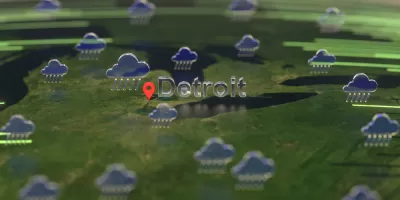
Ben Adler writes on the surprising impacts of climate change and extreme weather in the U.S. Midwest—where the summer has been marked by repeated flooding events in cities like Detroit.
The Detroit suburb of Gross Pointe Park is where Adler starts this story, in fact, at the home of Colin Moulder-McComb, which has been flooding regularly enough to drive Moulder-McComb from the area—a perhaps unexpected manifestation of a climate refugee.
For Moulder-McComb, the flooding that once seemed like an anomaly is now a regularity, writes Adler:
While the climate in the Midwest has always been relatively wet, the frequency and severity of downpours has gotten notably worse in recent decades, due to climate change. Warmer temperatures have led to more evaporation and precipitation. Between 1951 and 2017, the Great Lakes region’s average temperature increased 2.3 degrees Fahrenheit, its annual rainfall has risen 17% and it has 35% more heavy rain events, according to a study by Great Lakes Integrated Sciences and Assessments, a collaboration between the University of Michigan and Michigan State University, supported by the National Oceanic and Atmospheric Administration.
And the city of Detroit is suffering terrible effects from the change in the weather: "Between 2012 and 2020, 43 percent of homes in Detroit suffered flooding from rain, according to a recent survey of residents. Conditions like deteriorating roofs and cracks in basement walls made flooding more likely, and African American neighborhoods were more likely to flood than white areas."
Both Adler and Moulder-McComb acknowledge that it's hard to escape the effects of climate change anywhere in the country. But for a region with several advantages in the climate of the world to come—an abundance of fresh water being one of those advantages—it's frightening to see a lack refuge.
FULL STORY: How Midwesterners are handling constant flooding caused by climate change

The Great Flood of 2019, Visualized
The New York Times has published a spectacular mapping and data project to show the extent of flooding along the Mississippi River and its tributaries in the winter, spring, and summer of 2019.
A Toolbox of Green Infrastructure Solutions to Flooding Risks
A new one-stop shop for green infrastructure solutions is available to planners and engineers challenged by flooding.
How US Communities Are Building Resilience Against Flooding
Flooding causes over $400 billion in damage in the United States every year.

The state-sanctioned urbicide of Austin
People don’t kill cities. Freeways do.

US to reduce Colorado River water deliveries to Mexico
A new Colorado Treaty amendment reduces Mexico’s Colorado River water allocation by 250,000 acre feet.

New Jersey’s second-largest city bans standalone data centers
Jersey City will continue to allow co-location facilities, such as those meant for research institutions that store their own data.

Amtrak not solely to blame for New Jersey commuter rail's unreliability, report finds
A new study from the Garden State Initiative found that NJ Transit’s budget grew 20% across a 4 year period, but reliability declined significantly over the same period.

EPA erases limits on planet-warming pollution from power plants
Under Monday’s plan, power plants would still have some limits on how much mercury, arsenic and other contaminants they can emit.

Phoenix announces new on-demand transit service, more frequent RAPID buses
Both new services will launch in October, and are part of Phoenix's Project Effective Access Solutions for Easing Congestion.

FREE Course: Walkable City 1: Why Walkability?
After describing his path towards focusing on walkability as the essence of good planning, Jeff Speck marches through his five principal reasons for making more walkable places.
Reinventing Malls: Planning Alchemy—Turning Gray Fields Into Gold
The course focuses on the opportunities and imperatives that shape reinvention of mall sites.

Eagle County Government
Harvard University Graduate School of Design
Nashville Planning Department
The Architects Foundation
University of Cincinnati Online
The Pocatello Development Authority
The Urban Renewal Agency of the City of Pocatello
Journal of the American Planning Association