The housing initiatives developed after Hurricane Katrina teach valuable lessons for post-pandemic affordable housing production.



"Skyrocketing rents over the last decade combined with housing developments geared toward the wealthy have pushed musicians, artists and hospitality and service industry workers further and further from their jobs in the French Quarter, CBD and Marigny" neighborhoods of New Orleans, writes Sarah Ravits. "And now, the COVID-19 pandemic and looming evictions once again have thousands of New Orleanians desperate and frustrated."
But 16 years after Hurricane Katrina devastated the city, "New Orleans has something of a road map to follow" when it comes to creating more affordable housing. Ravits highlights examples such as Musicians' Village, a Habitat for Humanity project that built housing for 70 residents who lost their homes in Katrina, as proof that "it’s possible to create quality, long-term affordable housing for the artists and workers who are the backbone of New Orleans."
Casius Pealer, director of Tulane’s Master of Sustainable Real Estate Development program, says the biggest lesson from post-Katrina housing "is similar to the housing lesson we have learned in the pandemic: Housing is infrastructure." Musicians' Village "was a unique partnership between private funders, nonprofits and government which were able to come together in a remarkably short period of time to solve an enormous problem."
"As housing continued to be a challenge, other projects took form in the years immediately following Katrina. These housing initiatives were designed to help subsidize and support the city’s creatives and low- to medium-income earners." HousingNOLA’s Executive Director Andreanecia Morris "sees New Orleans as a place that could set a national standard on how to get its working class into reliable houses. The city’s previous experience with rebuilding and some of its post-Katrina developments could be inspirational to other struggling cities who are also experiencing a housing crisis."
Read the full story: Model homes: Sixteen years on it’s time to learn lessons from post-Katrina housing initiatives

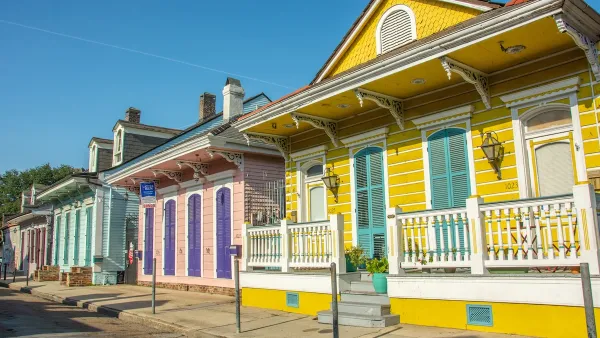
20 Years After Katrina, New Orleans is More Unaffordable Than Ever
The city’s post-hurricane redevelopment has failed to include its most vulnerable residents.
'New Orleans Saved Itself': Cutting-Edge Community Planning Post-Katrina
Ten years ago, a number of architecture firms went to New Orleans in the wake of Hurricane Katrina for a humanitarian "experiment"—rebuilding part of the underserved Lower Ninth Ward as an innovative, LEED Platinum, affordable community.
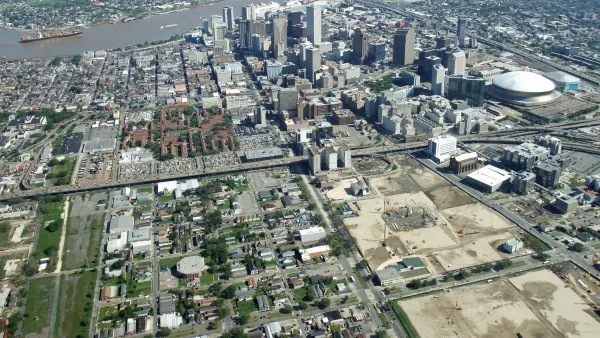
New Orleans Public Housing in Decade-Long Stall
In the aftermath of Katrina, President Obama's Choice Neighborhoods initiative promised thousands of new affordable units. But so far the Housing Authority of New Orleans hasn't proved up to the task.

Planetizen Federal Action Tracker
A weekly monitor of how Trump’s orders and actions are impacting planners and planning in America.

Amtrak, CN end decades-long dispute with eight-year agreement
The new operating agreement establishes an updated framework for the companies to work together, including processes to resolve disputes.
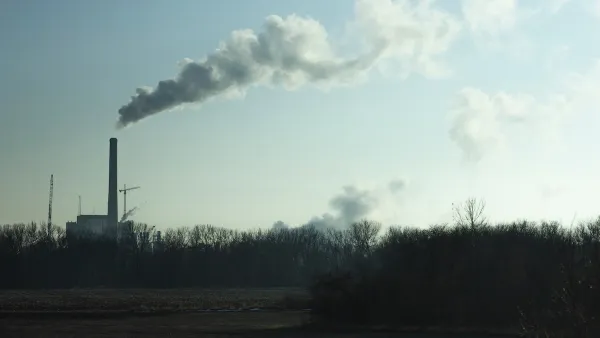
Nation's most wind-powered state turns to coal as data centers increase energy demand
For the first time in decades, Iowa has increased its generation of coal power.

Alabama scores up to $2.5 billion federal loan for largest infrastructure project in state’s history
The Mobile River Bridge and Bayway Project aims to ease congestion at Alabama’s worst bottleneck.

Trump is considering data centers on 6 states' public land — some state officials say they had no idea
If the administration approves the proposed projects, data center and data center-related developments will cover 17,600 acres of public land.

Despite court ruling, Trump is keeping nearly all wind projects in the US on hold
At least 110 wind energy projects have not heard from the government since a federal judge ruled that the Trump administration's freeze on wind turbine clearances was likely illegal.

FREE Course: Walkable City 1: Why Walkability?
After describing his path towards focusing on walkability as the essence of good planning, Jeff Speck marches through his five principal reasons for making more walkable places.
Reinventing Malls: Planning Alchemy—Turning Gray Fields Into Gold
The course focuses on the opportunities and imperatives that shape reinvention of mall sites.

KFH Group Inc.
Greater Baltimore Committee
Eagle County Government
The Architects Foundation
University of Cincinnati Online
The Pocatello Development Authority
The Urban Renewal Agency of the City of Pocatello