Geoff Palmer is suing the Los Angeles, seeking $100 million to make up for income lost because of the city's eviction moratorium during the pandemic.



"One of the region’s most prolific apartment builders has sued the city of Los Angeles over its COVID-19 eviction moratorium, saying his companies have experienced 'astronomical' financial losses and are legally entitled to compensation from the city," reports David Zahniser.
The developer claiming the losses is none other than Geoff Palmer, a frequent antagonist of the city when it comes to land use regulations and development.
"GHP Management Corp., which is owned by real estate developer Geoffrey Palmer, said in its lawsuit that 12 buildings that it manages have experienced more than $20 million in lost rental income as a result of the measure," according to Zahniser.
The lawsuit accuses the city's moratorium of violating the "Takings Clause" of the 5th Amendment of the U.S. Constitution. "Palmer’s companies said they are entitled to compensation of more than $100 million," according to Zahniser.
Lawsuits have previously cited the Takings Clause in legal controversies regarding eminent domain, inclusionary zoning, and rent control.
Read the full story: Landlord sues L.A. for $100 million, saying anti-eviction law caused ‘astronomical’ losses
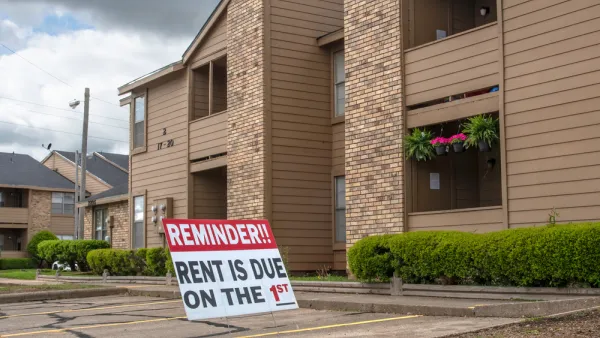
Landlords, Investors Lining Up to Evict Non-Paying Tenants
Rental housing is booming business, and some landlords and their investors see additional dollar signs in the potential to evict tenants protected by eviction moratoria up until this point in the pandemic.
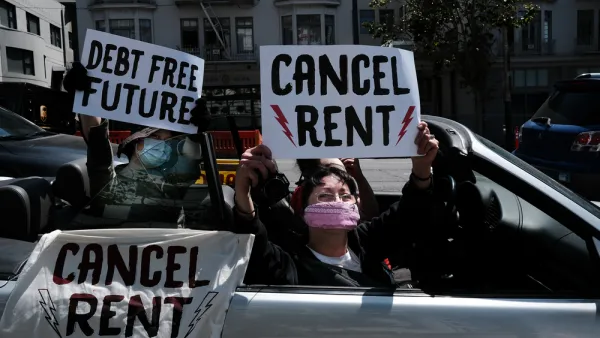
Opinion: CDC Eviction Moratorium Is Ineffective, Unnecessary
The effects of the pandemic economic shutdown on the rental market have been far lower than feared—at least at aggregate, not individual, levels. Is an eviction moratorium the most helpful tool at this point in the pandemic?

Federal Judge Tosses CDC's Eviction Moratorium
"The CDC order must be set aside," said U.S. District Judge Dabney Friedrich in a ruling announced Wednesday, May 5.

Planetizen Federal Action Tracker
A weekly monitor of how Trump’s orders and actions are impacting planners and planning in America.

Eastern Nebraska is running out of electricity
Data centers and electrification are straining eastern Nebraska’s grid, throttling economic development.

Washington state to charge fee to drivers with fuel-efficient cars
Revenue from the fee will go towards supporting the state’s highways.

Instead of building new housing, LA developers are turning mansions into mega-mansions
In the richest areas, the number of houses valued at $30 million with demolition permits has skyrocketed since 2018.

Illinois considers spending $1 billion in taxpayer money on data center
A quantum computing campus and data center are currently under construction in Chicago.

As development costs rise, Boston moves to lessen affordable housing requirements
The Boston Zoning Commission and the City Council still need to approve Boston Mayor Michelle Wu’s proposed changes

FREE Course: Walkable City 1: Why Walkability?
After describing his path towards focusing on walkability as the essence of good planning, Jeff Speck marches through his five principal reasons for making more walkable places.
Reinventing Malls: Planning Alchemy—Turning Gray Fields Into Gold
The course focuses on the opportunities and imperatives that shape reinvention of mall sites.

City of Charlotte
City of Rosemead
Rutgers University, Edward J. Bloustein School of Planning and Public Policy
University of Michigan School for Environment and Sustainability (SEAS)
Hunter College, City University of New York (CUNY)
The Architects Foundation
City of Cambridge
The Pocatello Development Authority
The Urban Renewal Agency of the City of Pocatello