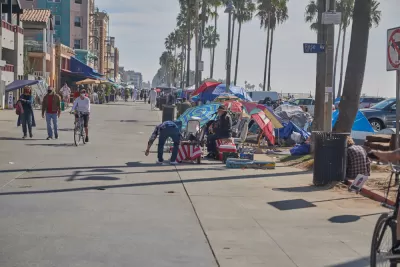
The controversies about homelessness in what was once a beach community full of hippies and surfers has boiled over in response to a large proposed development of supportive housing on a surface parking lot owned by the city.


In June, Planetizen picked up news of an innovative new supportive housing project in Los Angeles. The project was designed by Eric Owen Moss Architects, a world renowned but locally based architecture firm, to bridge the Venice Canals and provide housing in one of the most affluent and historic parts of the city.
Fast forward to July, and Alissa Walker is reporting for Curbed about the less-than-favorable response for the project among local residents—in a neighborhood embroiled in an ongoing controversy involving City Council recalls and the county's controversial sheriff. A small group of local homeowners is planning to sue to stop the development, according to Walker, "hoping to contest the legality of a state law that allows affordable housing projects to skip environmental review."
According to Walker, opponents believe the project to be evidence of the city's plans to turn Venice into a "homeless containment zone." They would prefer a 43,000-square-foot, 600-space parking garage to be built on the lot instead.
Meanwhile, an estimated 2,000 people experiencing homelessness live on the streets of the neighborhood—the highest density homeless population outside of Skid Row adjacent to Downtown. The latest controversies about what to do about the large homeless population are detailed in the source article by Walker.
A separate article by Steven Sharp from May also provides details on the proposed project, including the latest renderings. Sharp first broke the news about the planned development in December 2018.
FULL STORY: Even a Starchitect’s Homeless Housing Project Won’t Sway Venice Beach NIMBYs

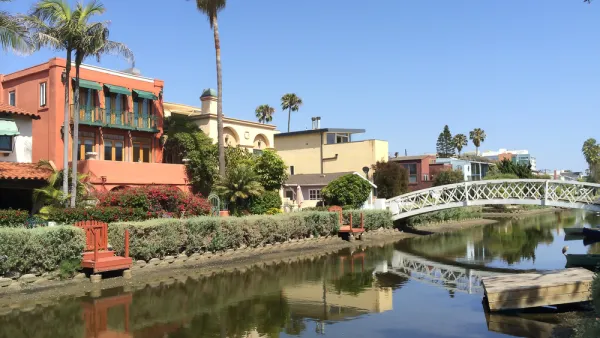
Supportive Housing Bridging Venice Canals Granted Planning Commission Approval in L.A.
The mixed-use Reese Davidson Community will include 140 housing units, commercial space, and a performance space.
Survey: 59% of LA Residents Want Dense Housing in Their own Neighborhoods
A UCLA survey reveals strong support for new apartments across the city, bucking the notion that Angelenos are NIMBYs.
LA Opposes California Bill to add Housing Next to Transit Hubs
In a narrow vote, the city council voted to oppose SB79, a bill that would bypass local zoning laws to allow denser development near transit stops.

The state-sanctioned urbicide of Austin
People don’t kill cities. Freeways do.

US to reduce Colorado River water deliveries to Mexico
A new Colorado Treaty amendment reduces Mexico’s Colorado River water allocation by 250,000 acre feet.

New Jersey’s second-largest city bans standalone data centers
Jersey City will continue to allow co-location facilities, such as those meant for research institutions that store their own data.

Amtrak not solely to blame for New Jersey commuter rail's unreliability, report finds
A new study from the Garden State Initiative found that NJ Transit’s budget grew 20% across a 4 year period, but reliability declined significantly over the same period.

EPA erases limits on planet-warming pollution from power plants
Under Monday’s plan, power plants would still have some limits on how much mercury, arsenic and other contaminants they can emit.

Phoenix announces new on-demand transit service, more frequent RAPID buses
Both new services will launch in October, and are part of Phoenix's Project Effective Access Solutions for Easing Congestion.

FREE Course: Walkable City 1: Why Walkability?
After describing his path towards focusing on walkability as the essence of good planning, Jeff Speck marches through his five principal reasons for making more walkable places.
Reinventing Malls: Planning Alchemy—Turning Gray Fields Into Gold
The course focuses on the opportunities and imperatives that shape reinvention of mall sites.

Eagle County Government
Harvard University Graduate School of Design
Nashville Planning Department
The Architects Foundation
University of Cincinnati Online
The Pocatello Development Authority
The Urban Renewal Agency of the City of Pocatello
Journal of the American Planning Association