To take on President Biden's ambitious housing goals, the agency needs to restore the staff lost during the Trump era.



To make the federal Department of Housing and Urban Development "into a frontline weapon in the fight against racial and economic inequality," writes Glenn Thrush in the New York Times, President Biden must first restore a department decimated by Trump-era cuts in budget and staffing. "In some divisions, as many as 25 to 30 percent of jobs were unfilled or occupied by interim employees. The losses were concentrated among the ranks of highest-skilled managers and policy experts, many of whom had been overruled, sidelined, exiled and eventually driven away under President Donald J. Trump and his appointees." Between 2012 and 2019, the agency lost 20% of its total employees. "Until we can start to build up our staff, and build up our capacity, we are at risk of not doing the things we should do," said HUD Secretary Marcia Fudge.
"The administration’s relief package, passed in March, included $21.55 billion for emergency rental assistance, $5 billion in emergency housing vouchers, $5 billion for homelessness assistance and $850 million for tribal and rural housing, on top of a similar amount allocated under the Trump administration," amounting to "the greatest increase in housing and related programs in decades. Mr. Biden’s infrastructure bill, now the subject of intense negotiations on Capitol Hill, would provide $213 billion more."
According to Fudge, the losses "are hindering distribution of emergency aid to low-income tenants and leaving many localities without guidance from experienced HUD employees on how to run new programs funded by the flood of coronavirus assistance cash." Meanwhile, some lawmakers worry about the depleted department's ability to manage the incoming funding and new responsibilities proposed by President Biden's infrastructure bill.
FULL STORY: Biden’s First Task at Housing Agency: Rebuilding Trump-Depleted Ranks

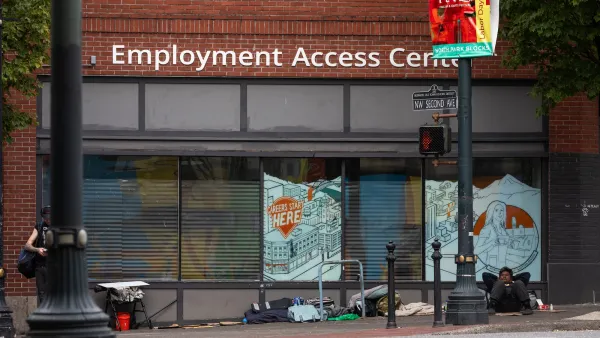
Judge: HUD acted illegally in changing homelessness grant rules
A Rhode Island judge struck down 'partisan' Trump restrictions on Continuum of Care Build grants.

Trump's “Able Bodied” Public Housing Limits Could Displace Over 300,000 New Yorkers
As part of 43% cut to federal rental assistance, Trump is proposing a two-year limit on public housing tenure for “able bodied adults.”

$5 Billion Rental Assistance Fund Set to Run Out of Cash
“No additional funding from HUD will be forthcoming,” HUD announces.

The state-sanctioned urbicide of Austin
People don’t kill cities. Freeways do.

US to reduce Colorado River water deliveries to Mexico
A new Colorado Treaty amendment reduces Mexico’s Colorado River water allocation by 250,000 acre feet.

New Jersey’s second-largest city bans standalone data centers
Jersey City will continue to allow co-location facilities, such as those meant for research institutions that store their own data.

Amtrak not solely to blame for New Jersey commuter rail's unreliability, report finds
A new study from the Garden State Initiative found that NJ Transit’s budget grew 20% across a 4 year period, but reliability declined significantly over the same period.

EPA erases limits on planet-warming pollution from power plants
Under Monday’s plan, power plants would still have some limits on how much mercury, arsenic and other contaminants they can emit.

Phoenix announces new on-demand transit service, more frequent RAPID buses
Both new services will launch in October, and are part of Phoenix's Project Effective Access Solutions for Easing Congestion.

FREE Course: Walkable City 1: Why Walkability?
After describing his path towards focusing on walkability as the essence of good planning, Jeff Speck marches through his five principal reasons for making more walkable places.
Reinventing Malls: Planning Alchemy—Turning Gray Fields Into Gold
The course focuses on the opportunities and imperatives that shape reinvention of mall sites.

Eagle County Government
Harvard University Graduate School of Design
Nashville Planning Department
The Architects Foundation
University of Cincinnati Online
The Pocatello Development Authority
The Urban Renewal Agency of the City of Pocatello
Journal of the American Planning Association