The proposed rule would apply to residents of multifamily housing supported by federal rental assistance.



A proposed rule from the U.S. Department of Housing and Urban Development (HUD) would make permanent a pandemic-era regulation governing affordable housing residents at risk of eviction, reports Kimberly Bonvissuto in McKnight Senior Living.
The rule would mandate a 30-day notification period for evictions for rent nonpayment. “The proposed rule also would require the notice to include instructions on how residents can resolve lease violations, and information on how to recertify their income and request a minimum rent hardship exemption, if applicable, to avoid eviction.”
The rule could impact as many as 3.9 million people. “HUD estimated that 70% of HUD-assisted households for PBRAs and public housing live in states that require housing provides to provide tenants with an eviction notice seven days or less before eviction, 26% of these households live in states that require eight to 14 days notice, and 3% live in states that require 15 to 30 days notice.”
FULL STORY: Proposed HUD rule formalizes pandemic-era protections for affordable housing residents


Boulder's Eviction Prevention Program, One Year Later
A program created last year to assist tenants and prevent evictions has helped close to 400 households in its first year.
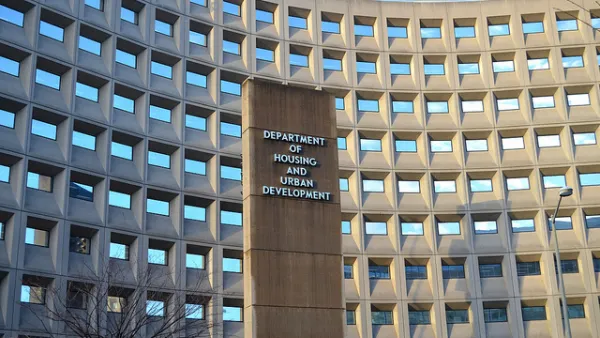
HUD Secretary: Administration Must Restore Depleted Staff
To take on President Biden's ambitious housing goals, the agency needs to restore the staff lost during the Trump era.

Analysis: ROAD to Housing Act could take years to implement
HUD is tasked with implementing nine new rules as part of the ROAD to Housing Act — while operating with a significantly reduced staff.

Planetizen Federal Action Tracker
A weekly monitor of how Trump’s orders and actions are impacting planners and planning in America.

The state-sanctioned urbicide of Austin
People don’t kill cities. Freeways do.

US to reduce Colorado River water deliveries to Mexico
A new Colorado Treaty amendment reduces Mexico’s Colorado River water allocation by 250,000 acre feet.

5 New England states march closer to 800 megawatt wind energy project
Securing federal approval for the project may be complicated under the Trump administration, which has historically been hostile towards domestic wind power.

Baltimore to break ground on $50 million Transit Priority Project
The project will bring faster bus trips, safer streets and better bike connections to Baltimore.

Airbnb launches $250 million 'last-dollar financing' housing accelerator, makes first investment in Austin
The company will put $6.4 million towards affordable housing development in Texas’ capital.

FREE Course: Walkable City 1: Why Walkability?
After describing his path towards focusing on walkability as the essence of good planning, Jeff Speck marches through his five principal reasons for making more walkable places.
Reinventing Malls: Planning Alchemy—Turning Gray Fields Into Gold
The course focuses on the opportunities and imperatives that shape reinvention of mall sites.

.jpg)
Eagle County Government
Harvard University Graduate School of Design
Nashville Planning Department
The Architects Foundation
University of Cincinnati Online
The Pocatello Development Authority
The Urban Renewal Agency of the City of Pocatello
Journal of the American Planning Association