A tight vote after months of controversy has produced a major zoning reform effort that differs significantly from recent examples on the West Coast and in Minneapolis.



The city of Charlotte last week approved a new comprehensive plan that joins a small but growing list of cities to take steps toward abolishing single-family zoning.
"With a tight 6-5 vote, the City Council on Monday adopted the plan, which Mayor Vi Lyles has said is intended to disrupt the “status quo” and ensure equitable growth over the next two decades," reports Alison Kuznitz for the Charlotte Observer.
The Comprehensive Plan took years to gain approval, including a rough final few months in the City Council. A separate article by Kuznitz details four stumbling blocks the plan navigated on the way to approval: Covid-19, personal attacks, and controversies about density (i.e., duplexes and triplexes in single-family residential neighborhoods) and development agreements. "The final draft, according to Jaiyeoba, tries to better distinguish between community benefit agreements with developers — as a formal tool that leads to projects like childcare or open space — versus more general 'benefits to the community,' such as affordable housing," explains Kunitz.
The new density to be allowed in single-family residential neighborhoods also includes tiny homes and accessory dwelling units, reports Kuznitz. The opposition criticized the new density enabled by the plan, citing concerns about gentrification and neighborhood character.
Among the other goals laid out by the Charlotte Future 2040 Comprehensive Plan and reported by Kunitz is a target to create 10-minute neighborhoods, "where residents can access key amenities such supermarkets and child care within a 10-minute walk, bike ride or transit trip."
Notably: zoning changes targeted by the Charlotte Future 2040 Comprehensive Plan will not be implemented until the city also approves a Unified Development Ordinance—a process which must be complete by next year.
Charlotte's new comprehensive plan has also attracted national media attention. Henry Grabar writes for Slate that Charlotte's zoning reform effort now becomes the most significant effort in the country. According to Grabar, Charlotte's effort is more significant because it is growing faster than the other cities that have implemented this kind of reform: Berkeley, Portland, and Minneapolis. Among other factors, housing in Charlotte is still relatively cheap, too. Making the case for the reform in Charlotte, according to Grabar's assessment of the politics of the new comp plan, required a "dynamic city planning director, Taiwo Jaiyeoba," and repeated attention to single-family zoning as a tool of racial segregation.
FULL STORY: Charlotte now has a plan for equitable growth. Here’s what City Council decided.


The 'Most Pro-Housing Reform in U.S. History' Expected for Approval Today in Portland
The Portland Residential Infill Project is expected for approval by the Portland City Council today, culminating a six year process that became more and more ambitious with every iteration.

Gainesville Eliminates Single-Family Zoning
Gainesville is the first city in Florida to eliminate exclusionary zoning.
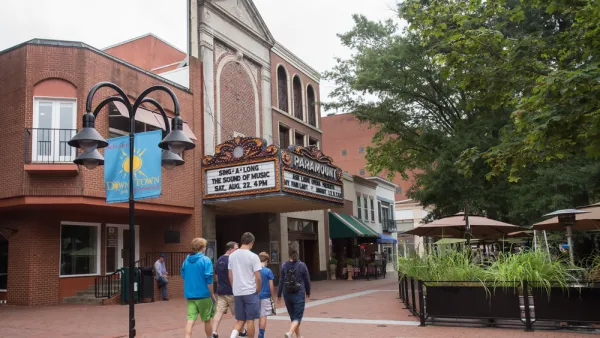
Controversial Comprehensive Plan Update Moves Forward in Charlottesville
Residents have had a chance to oppose the new residential density proposed by the "Charlottesville Plans Together" comprehensive planning process.

Planetizen Federal Action Tracker
A weekly monitor of how Trump’s orders and actions are impacting planners and planning in America.

The state-sanctioned urbicide of Austin
People don’t kill cities. Freeways do.

US to reduce Colorado River water deliveries to Mexico
A new Colorado Treaty amendment reduces Mexico’s Colorado River water allocation by 250,000 acre feet.

5 New England states march closer to 800 megawatt wind energy project
Securing federal approval for the project may be complicated under the Trump administration, which has historically been hostile towards domestic wind power.

Baltimore to break ground on $50 million Transit Priority Project
The project will bring faster bus trips, safer streets and better bike connections to Baltimore.

Airbnb launches $250 million 'last-dollar financing' housing accelerator, makes first investment in Austin
The company will put $6.4 million towards affordable housing development in Texas’ capital.

FREE Course: Walkable City 1: Why Walkability?
After describing his path towards focusing on walkability as the essence of good planning, Jeff Speck marches through his five principal reasons for making more walkable places.
Reinventing Malls: Planning Alchemy—Turning Gray Fields Into Gold
The course focuses on the opportunities and imperatives that shape reinvention of mall sites.

Eagle County Government
Harvard University Graduate School of Design
Nashville Planning Department
The Architects Foundation
University of Cincinnati Online
The Pocatello Development Authority
The Urban Renewal Agency of the City of Pocatello
Journal of the American Planning Association