The Pencoyd Landing development is focused on providing access to pedestrians, cyclists, and transit users in the neighborhood of Lower Merion Township, across the Schuylkill River from Philadelphia.


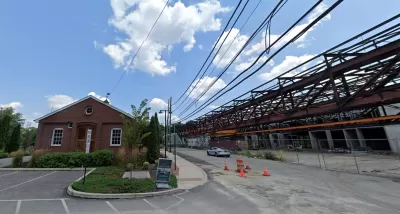
Pencoyd Iron Works, an abandoned industrial complex in Lower Merion, Pennsylvania, has been reimagined as Pencoyd Landing, "a modern waterfront complex that includes an elegant river walk, a tiny Victorian castle, a terrace restaurant and, improbably, a new Marriott hotel," writes Inga Saffron in the Philadelphia Inquirer. Despite its challenging location, "hemmed in by highways and high bluffs," developer Penn Group "has managed to use its difficult site to create a lush and cozy refuge from the world. Although not replicable everywhere, the results should inspire the region’s other waterfront projects to up their game."
Situated across the Schuylkill River from Philadelphia, the Pencoyd Landing site was acquired by Penn Group in 2000, "when it was still home to a rebar factory." Now, "[y]ou can meander along the river walk, stop for coffee or a meal at the Landing Kitchen (the latest offering from Philadelphia chef Nick Elmi), or admire the surviving ironworks structures."
One important feature of Pencoyd Landing is its connection to the adjacent trail and neighborhoods: "Most river sites are in floodplains, and developers don’t want to bother making provisions to deal with occasional high water. The result of that shortsighted approach can be seen along the Center City stretch of the Schuylkill, where a parade of garages is creating a wall between the river and the adjacent neighborhoods." Instead, "Pencoyd Landing was designed to be equally accessible to pedestrians, cyclists and transit riders." Donna Galvin, Penn Group co-founder, "decided it was worth taking her chances and keeping the new buildings as close to trail level as possible."
Read the full story: Lower Merion suddenly has a walkable riverfront, thanks to Pencoyd Landing development


Surveying the Rising Trend of Office-to-Residential Conversions
With office vacancies climbing and a stubborn supply crunch driving up the cost of housing, some downtowns have emerged at the forefront of a new wave of adaptive reuse.

Philadelphia Leads the Way in Adaptive Reuse
Philadelphia, a city rife with historic architecture, seeks to incentivize more conversion of historic buildings into housing.

Looking to Vacant Retail Spaces for Needed Housing Supply
The Phoenix City Council has taken the first steps toward zoning reforms that can balance out the oversupply of retail spaces at one end of the market and the lack of housing units at the other.

Planetizen Federal Action Tracker
A weekly monitor of how Trump’s orders and actions are impacting planners and planning in America.

The state-sanctioned urbicide of Austin
People don’t kill cities. Freeways do.

US to reduce Colorado River water deliveries to Mexico
A new Colorado Treaty amendment reduces Mexico’s Colorado River water allocation by 250,000 acre feet.

Nation's most wind-powered state turns to coal as data centers increase energy demand
For the first time in decades, Iowa has increased its generation of coal power.

NYC cools commuters with city's first rain garden above a bus stop
New York City officials say the plants in the rain garden can absorb 16 gallons of rainwater during heavy storms.

Brightline West’s future may rely on $6 billion federal loan
The company has until Nov. 2 to make a $400 million equity investment into its proposed high-speed rail line.

FREE Course: Walkable City 1: Why Walkability?
After describing his path towards focusing on walkability as the essence of good planning, Jeff Speck marches through his five principal reasons for making more walkable places.
Reinventing Malls: Planning Alchemy—Turning Gray Fields Into Gold
The course focuses on the opportunities and imperatives that shape reinvention of mall sites.

Eagle County Government
Harvard University Graduate School of Design
Nashville Planning Department
The Architects Foundation
University of Cincinnati Online
The Pocatello Development Authority
The Urban Renewal Agency of the City of Pocatello
Journal of the American Planning Association