Taking lessons from his time working in the Obama administration, President Biden is tempering promises of quick job creation with long-term reinvestment.


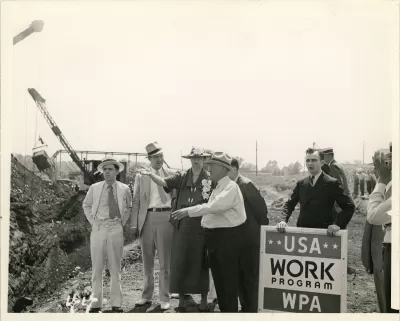
Learning from his experience as vice president, Joe Biden knows that "you can’t expect immediate results" when it comes to infrastructure spending and job creation, writes Jake Blumgart for Governing. "[H]istorically, public works projects have a complicated history when it comes to quickly getting a lot of people back to work." That makes infrastructure spending "bad stimulus spending" despite its long-term benefits.
The concept of "shovel-ready projects," a term popularized by President Obama in late 2008, proved deceptive. Research shows that in most areas of governance, "it took at least one year to set up a project and another two to three years to actually spend the money." Learning from these prior experiences, President Biden is taking a longer view. "The Biden administration’s rhetoric around the American Jobs Act is, obviously, about job creation. But the $2 trillion plan is not about juicing the economy in 2021, or even in the crucial midterm election year of 2022. Instead, it is meant to unfold over the course of a decade."
The public works programs of the New Deal era, according to Jason Scott Smith, assistant professor of history at the University of New Mexico, "are better understood not as unsuccessful state-employment measures, but rather as a strikingly effective method of state-sponsored economic development." By framing the American Jobs Act as long-term reinvestment, Biden is avoiding the "poor job of setting out expectations" that plagued the Obama administration.
FULL STORY: The Economic Lessons Biden Learned from Obama and Roosevelt

Historic 'Infrastructure Investment and Jobs Act' Passes Final Hurdle in Congress, Heads to Biden for Signature
Months after the Senate voted to approve the Infrastructure Investment and Jobs Act in a historic moment of bipartisan legislation, the House of Representatives put the finishing touches on a $1.2 trillion bill with $550 million in new spending.
Looking Back on the 5th Anniversary of the Federal Stimulus
The American Recovery and Reinvestment Act (ARRA) was signed into law on February 17, 2009, less than a month into President Obama's first term. The Council of Economic Advisers recently presented its final quarterly report on ARRA's impacts.
Preservation Office Delaying Stimulus Projects in California
California stimulus projects and job creation are being delayed by a state office tasked with reviewing federally-funded construction projects to prevent adverse affects on historic sites, according to a new report.

Planetizen Federal Action Tracker
A weekly monitor of how Trump’s orders and actions are impacting planners and planning in America.

The state-sanctioned urbicide of Austin
People don’t kill cities. Freeways do.

US to reduce Colorado River water deliveries to Mexico
A new Colorado Treaty amendment reduces Mexico’s Colorado River water allocation by 250,000 acre feet.

Mamdani overhauls NYC's Vision Zero plan with 100 new policy goals
The overhaul aims to reduce traffic deaths and make streets safer for pedestrians, cyclists and drivers through lower speed limits, new safety infrastructure and more.

Amtrak not solely to blame for New Jersey commuter rail's unreliability, report finds
A new study from the Garden State Initiative found that NJ Transit’s budget grew 20% across a 4 year period, but reliability declined significantly over the same period.

EPA erases limits on planet-warming pollution from power plants
Under Monday’s plan, power plants would still have some limits on how much mercury, arsenic and other contaminants they can emit.

FREE Course: Walkable City 1: Why Walkability?
After describing his path towards focusing on walkability as the essence of good planning, Jeff Speck marches through his five principal reasons for making more walkable places.
Reinventing Malls: Planning Alchemy—Turning Gray Fields Into Gold
The course focuses on the opportunities and imperatives that shape reinvention of mall sites.

Eagle County Government
Harvard University Graduate School of Design
Nashville Planning Department
The Architects Foundation
University of Cincinnati Online
The Pocatello Development Authority
The Urban Renewal Agency of the City of Pocatello
Journal of the American Planning Association