The city could give 2,000 families $1,000 a month in what would be the largest program of its kind in the country.



If approved, a $24 million guaranteed income program in Los Angeles would be "the largest experiment of its kind in the United States" to date, writes Libby Denkmann in LAist. "Under the proposal, dubbed 'BIG: LEAP' (Basic Income Guaranteed: L.A. Economic Assistance Pilot), 2,000 Angeleno families at or below the federal poverty line would receive $1,000 a month for one year, no strings attached."
Los Angeles mayor Eric Garcetti told LAist "For families who can't think past the next bill, the next shift or the next health problem that they have, we can give them the space to not only dream of a better life, but to actualize it." The plan will likely include additional selection criteria such as "supporting a child under the age of 18 and a demonstrated medical or financial hardship connected to COVID-19."
"If successful, the Los Angeles pilot would serve as a major proof-of-concept for direct cash assistance that is divorced from the work requirements attached to many safety net programs for poor Americans, such as the Earned Income Tax Credit."
The concept of guaranteed income is nothing new. According to Michael Tubbs, former mayor of Stockton and one of the first city officials to push for a guaranteed income program in their city, "Dr. King called for guaranteed income in 1967. But the pandemic really illustrated the ways the economy isn't working for many people," paving the way for more cities across the country to consider some type of cash assistance. "It's a really important time to revisit the assumptions that have been underlying our existing welfare programs," says Nika Soon-Shiong, program director for the city of Compton's guaranteed income program, which launched this January.
Read the full story: $1,000 A Month, No Strings Attached: Garcetti Proposes A Guaranteed Basic Income Pilot In Los Angeles

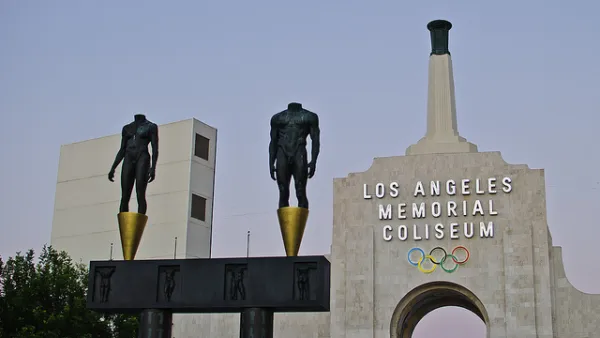
L.A. Seeking Funding for New Transit Projects Prior to the 2028 Summer Olympics
Los Angeles officials have been working for years to deliver a suite of transit projects in time for the 2028 Olympics. Planners now hope federal infrastructure funding could reinvigorate the effort.

Guaranteed Income Program Launched in Arlington, Virginia
The 18-month pilot program will provide $500 to 200 low-income families in the county.

Los Angeles Mayor Blames COVID Outbreak on Density
Appearing on a Sunday news show, Mayor Eric Garcetti noted that the Los Angeles metropolitan region is the nation's densest and one of two primary reasons why "we're seeing a person every six seconds contract COVID-19 here in Los Angeles County."

Planetizen Federal Action Tracker
A weekly monitor of how Trump’s orders and actions are impacting planners and planning in America.

Northwest rail fans eager for Sept. 30 debut of Amtrak’s Airo fleet
Get ready for that new train smell and more seats. But they won’t go faster or run more frequently on the Cascades route in Washington and Oregon.

Record-breaking wildlife overpass in Colorado brings 91% reduction in animal collisions
Prior to the overpass, vehicles were hitting one deer per day on Colorado’s Interstate 25.

Detroit to transform waterfront with $2.2 billion investment
Developers will convert about 18 acres of unused parking lot space into civic spaces.

‘Going backwards:’ Baltimore mayor, students rally against state's transit funding plan
Maryland's proposed six-year plan provides no funding for Baltimore’s BMORE bus program and reduces its road maintenance funding.

Trump wants to cancel nearly 98% of funding for HUD housing support program
Multiple housing groups are suing the administration in an effort to preserve the funding.

FREE Course: Walkable City 1: Why Walkability?
After describing his path towards focusing on walkability as the essence of good planning, Jeff Speck marches through his five principal reasons for making more walkable places.
Reinventing Malls: Planning Alchemy—Turning Gray Fields Into Gold
The course focuses on the opportunities and imperatives that shape reinvention of mall sites.

City of Thousand Oaks
City of Wisconsin Rapids
Harvard University Graduate School of Design
The Architects Foundation
University of Cincinnati Online
Northern Illinois Transit Authority (NITA)
The Pocatello Development Authority
The Urban Renewal Agency of the City of Pocatello