Along with communal showers and bathrooms, the village will also include laundry, storage facilities, and offices for social service providers.


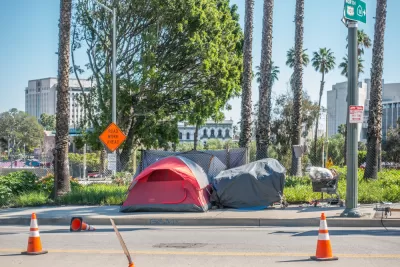
A community of tiny shelters aimed at helping unhoused people transition to more permanent housing is being built in a vacant lot in Los Angeles' Echo Park neighborhood, where the neighborhood's eponymous park recently became a flashpoint of the heated debate over the city's perennial and growing homelessness crisis.
"The village's 38 cabin-like structures will contain a total of 74 beds, according to Alexis Florio, speaking for Lehrer Architects. The prefabricated units are made off-site by a company called Pallet" and can be assembled in under an hour, writes Barry Lank for The Eastsider LA. "In addition, contractors are assembling a hygiene trailer with toilets and five showers. The village also include[s] a guard booth, a storage unit, and a large administration office unit with a laundry facility and room for social service officials." The structures cost around $9,000 each including installation, with a total project cost of $3 million—well below the close to $5.7 million budget approved for the project. Operations costs for the site are expected to be $1,485,550 for Fiscal Year 2021-2022.
Earlier this spring, Echo Park Lake, located less than a mile to the south of the tiny home village, was the site of a tense standoff between unhoused residents and their advocates and police as the city cleared the massive encampment that had developed in the park during the pandemic. While the city has placed many of the former park residents in hotel rooms via Project Roomkey, advocates say the forceful removal was unnecessary and the services provided are inadequate, especially during a pandemic.
FULL STORY: A "village" of 64-square-foot homeless shelters is taking shape in an Echo Park parking lot


A 'Tiny Home Village' Grows in Los Angeles
The complex can house over 200 people and will provide bathrooms and social services for people transitioning out of homelessness.
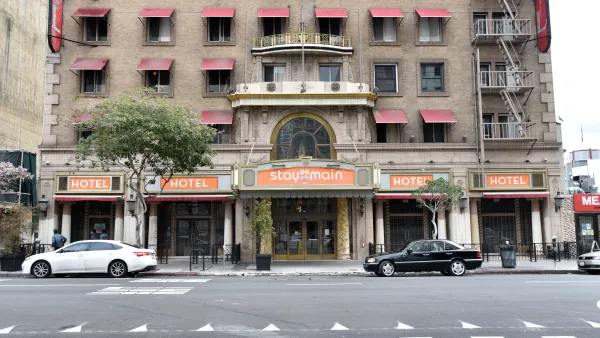
$150 Million for L.A.’s Unhoused People Go Unspent
The city returned nearly $150 million in federal funding directed to providing shelter and supportive services to the Department of Housing and Urban Development.
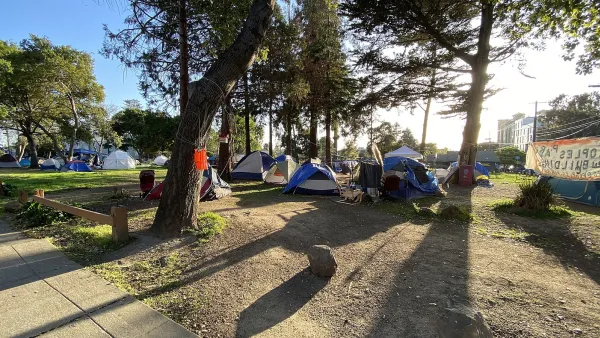
UC Berkeley Commits to Supportive Housing Project in People's Park
The university will work with the city and local nonprofits to provide 42 units of housing and supportive services to unhoused people living in Berkeley's iconic People's Park.

The state-sanctioned urbicide of Austin
People don’t kill cities. Freeways do.

US to reduce Colorado River water deliveries to Mexico
A new Colorado Treaty amendment reduces Mexico’s Colorado River water allocation by 250,000 acre feet.

New Jersey’s second-largest city bans standalone data centers
Jersey City will continue to allow co-location facilities, such as those meant for research institutions that store their own data.

Amtrak not solely to blame for New Jersey commuter rail's unreliability, report finds
A new study from the Garden State Initiative found that NJ Transit’s budget grew 20% across a 4 year period, but reliability declined significantly over the same period.

EPA erases limits on planet-warming pollution from power plants
Under Monday’s plan, power plants would still have some limits on how much mercury, arsenic and other contaminants they can emit.

Phoenix announces new on-demand transit service, more frequent RAPID buses
Both new services will launch in October, and are part of Phoenix's Project Effective Access Solutions for Easing Congestion.

FREE Course: Walkable City 1: Why Walkability?
After describing his path towards focusing on walkability as the essence of good planning, Jeff Speck marches through his five principal reasons for making more walkable places.
Reinventing Malls: Planning Alchemy—Turning Gray Fields Into Gold
The course focuses on the opportunities and imperatives that shape reinvention of mall sites.

Eagle County Government
Harvard University Graduate School of Design
Nashville Planning Department
The Architects Foundation
University of Cincinnati Online
The Pocatello Development Authority
The Urban Renewal Agency of the City of Pocatello
Journal of the American Planning Association