Millions of fully vaccinated Americans who have been anxiously awaiting new guidance from the Centers for Disease Control and Prevention on what they can now do safely were given initial recommendations that apply only to private settings.


"As of today [March 8], 59 million people in the United States have received at least one dose of COVID-19 vaccine, and approximately 31 million or 9.2 percent of the U.S. population is fully vaccinated, putting us on a strong path to eventually end this pandemic," stated Dr. Rochelle Walensky, the director of the Centers for Disease Control and Prevention (CDC), at the beginning of her presentation during Monday morning's White House COVID-19 Response Team press briefing (view the 37-minute video on YouTube).
And with more and more people getting vaccinated each day, we are starting to turn a corner.
This is why, today, CDC is releasing its initial guidance for the public that, for the first time, lays out some of the activities considered safe for those who are fully vaccinated. When I say "fully vaccinated," I mean people who are two weeks after their second dose of either the Pfizer or Moderna vaccines, or two weeks after a single dose of the Johnson & Johnson vaccine.
Risk not eliminated with vaccination
For now, 'back to normal' for those fully vaccinated is restricted to private, as opposed to public settings. It is still possible for vaccinated people to become infected and transmit the virus to others. More on that possibility from a Bloomberg opinion editor who shares her personal story below with an expert.
"The new guidance—which is based on the latest science — includes recommendations for how and when a fully vaccinated individual can visit with other people who are fully vaccinated and with other people who are not vaccinated," states the CDC press release (source article) on the first set of guidelines on how fully vaccinated people can visit safely with others. [Also see CDC webpage, "When You’ve Been Fully Vaccinated: How to Protect Yourself and Others].
This guidance represents a first step toward returning to everyday activities in our communities.
"Everyone – even those who are vaccinated – should continue with all mitigation strategies when in public settings," said CDC Director Rochelle P. Walensky, MD, MPH. “There are some activities that fully vaccinated people can begin to resume now in their own homes. Everyone – even those who are vaccinated – should continue with all mitigation strategies when in public settings.”
The first two bullet points apply only within the confines of one's own home.
- Masks and social distancing are not necessary when meeting with other vaccinated people
- No precautions needed when meeting with unvaccinated people providing that:
- The other people represent a single household.
- None of the unvaccinated people from that single household are at risk of severe COVID-19.
Vaccinated, then infected
The third bullet in CDC's Interim Public Health Recommendations for Fully Vaccinated People should provide an incentive for every adult to be vaccinated:
- Refrain from quarantine and testing if [the fully vaccinated person] does not have symptoms of COVID-19 after contact with someone who has COVID-19.
If a fully vaccinated person experiences COVID-19 symptoms, regardless of with whom the person has been in contact, they should consider being tested to ensure they haven't been infected, which brings us to just such a case. But first, here's how Dr. Walensky characterized the infection risk during the briefing.
"However, there is still a small risk that vaccinated people could become infected with milder or asymptomatic disease, and potentially even transmit the virus to others who are not vaccinated. Understanding the size of this risk in vaccinated people and the risk of transmitting the virus to others who are not vaccinated is an ongoing area of research."
With that clarification, consider the experience of Mary Duenwald, a Bloomberg Opinion editor who became mildly ill with COVID-19 "a few weeks" after receiving her second dose of the Pfizer Inc.-BioNTech SE vaccine. She co-wrote the column, published March 5, with Sam Fazeli, a senior pharmaceuticals analyst for Bloomberg Intelligence.
Fazeli explains why people who are fully vaccinated can become infected.
The reality is that so-called sterilizing immunity, or protection that completely blocks a virus from infecting you, is rare. In fact, only one vaccine has been proven to provide that, and that is the smallpox shot...
It’s also possible that you are infected with a new variant, such as the one that is circulating in New York, known as B.1.526. These variants are potentially better at getting past your antibody immunity.
"My symptoms are mild, as if this were just a cold. Can I assume the shot is still protecting me?" asks Duenwald.
Fazeli: Of course. You will never know how bad your symptoms would have been if you had not been vaccinated, but they could have been much worse. The vaccines have high efficacy against severe and critical disease — indeed their main purpose is to keep people out of the hospital and lower their risk of dying.
Even the ones with apparently lower efficacy against mild and moderate disease, such as Johnson & Johnson’s shot, show better efficacy against severe and critical illness.
Fazeli addresses related issues raised by Duenwald, including transmissibility of the virus from vaccinated people, and COVID testing results in relation to virus incubation periods, which may be different from those who are unvaccinated. One of his answers, though, is contradicted by the second bullet in the aforementioned new CDC guidance, released three days after the Bloomberg opinion, which shows the importance of CDC's recommendations for the 31,493,040 Americans who were fully vaccinated as of March 8.
Media coverage of CDC's interim "fully vaccinated" guidelines
- Vaccinated Americans may gather indoors in small groups but should still wear masks in public, the C.D.C. said, The New York Times
- Fully vaccinated people can visit with nearby grandchildren, dine indoors with one another, CDC says, The Washington Post
- What you can and can’t do after getting fully vaccinated against COVID-19, Los Angeles Times
- Here's what the CDC says fully vaccinated people can do, CBS News
Related in Planetizen:
- A Fourth Coronavirus Surge is Likely, March 1, 2021
- Are We 'Rounding the Corner' in the Pandemic? February 16, 2021
Read the full story: CDC Issues First Set of Guidelines on How Fully Vaccinated People Can Visit Safely with Others
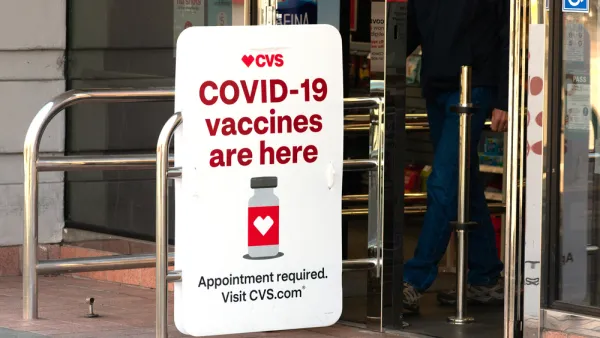
Will CDC's Revised Guidance for Fully Vaccinated People Prolong the Pandemic?
The CDC abruptly changed its masking guidance on May 13 to further distinguish behavior for those who are fully vaccinated from those who are not, prompting states, counties and businesses to end indoor mask mandates and social distancing.
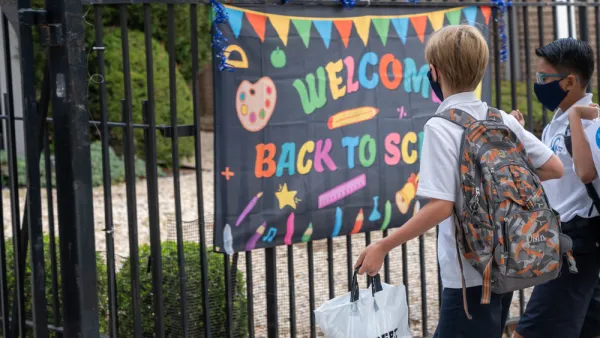
Reopening Schools: CDC Reduces Social Distancing Requirement
The Centers for Disease Control and Prevention now supports three-foot distancing in elementary school classrooms provided there is universal masking. For middle and high schools, it depends on the level of coronavirus transmission in the community.

Los Angeles County First to Recommend Resumption of Indoor Masking
Due to the emergence of the more transmissible Delta variant, Los Angeles County's masking guidance goes beyond what the CDC and the state health department recommend for those who are fully vaccinated. St. Louis has joined them.

Planetizen Federal Action Tracker
A weekly monitor of how Trump’s orders and actions are impacting planners and planning in America.

California plans to bury El Niño’s downpour
If the state plays its cards right, it may be able to store a billion acre-feet of El Niño’s water in aquifers.

Desperate measures: Advocates weigh draining Lake Powell to fill Colorado River
Draining the reservoir could reduce evaporation losses by a couple hundred thousand acre-feet.

Los Angeles just elected an urban planner as its mayor
Transportation analysts are optimistic that Raman will be more aggressive in addressing transit issues than Bass.

Mamdani’s pied-à-terre tax survives legal challenge
A panel of judges found that the plaintiffs failed to demonstrate injury as a result of New York City's implementation of the tax.

Eastern Nebraska is running out of electricity
Data centers and electrification are straining eastern Nebraska’s grid, throttling economic development.

FREE Course: Walkable City 1: Why Walkability?
After describing his path towards focusing on walkability as the essence of good planning, Jeff Speck marches through his five principal reasons for making more walkable places.
Reinventing Malls: Planning Alchemy—Turning Gray Fields Into Gold
The course focuses on the opportunities and imperatives that shape reinvention of mall sites.

City of Rosemead
Rutgers University, Edward J. Bloustein School of Planning and Public Policy
One Hundred Miles
University of Michigan School for Environment and Sustainability (SEAS)
Hunter College, City University of New York (CUNY)
The Architects Foundation
City of Cambridge
Montrose County
The Pocatello Development Authority