Trump's promised "impenetrable" wall has proven to be anything but.


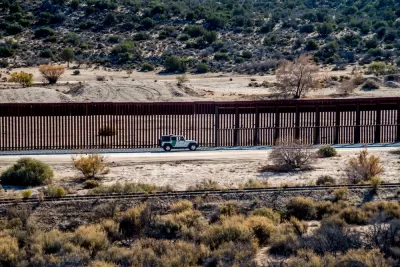
Writing in High Country News, Jonathan Thompson evaluates the failures of Trump's proposed border wall, a "boondoggle" that has cost millions of dollars, disrupted cross-border human and animal communities and migration patterns, and met with resistance from property owners all along the way.
Despite Trump's promise that the "impregnable" wall would span the full length of the U.S.-Mexico border, his administration managed to build about 450 miles of barrier, "none of which was concrete and all of which was demonstrably pregnable." Furthermore, evidence suggests that the hundreds of miles of barriers built under Presidents Clinton and George W. Bush "did very little to stop undocumented migration, in part because at least two-thirds of undocumented immigrants in the U.S. arrived on visas and then overstayed them." Yet since 2017, close to $15 billion have been appropriated to border wall construction by Congress.
Immediately after his inauguration, President Biden halted further construction of the border wall through an executive order. "Now, many observers are urging him to go further and dismantle the barrier, as well as try to repair the damage done."
FULL STORY: Border barrier boondoggle

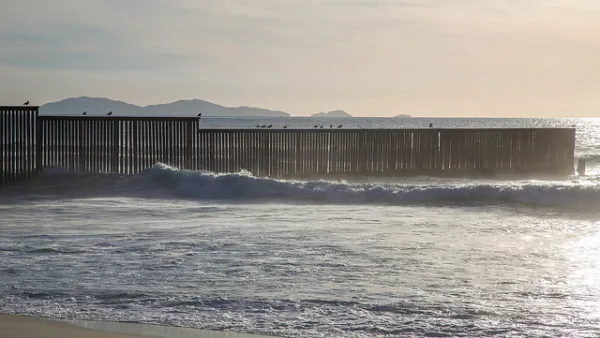
Department of Homeland Security Will Skip Environmental Review for the Border Wall
Also, the House of Representatives has approved the funding president trump wants for the wall, but the Senate is likely to balk.
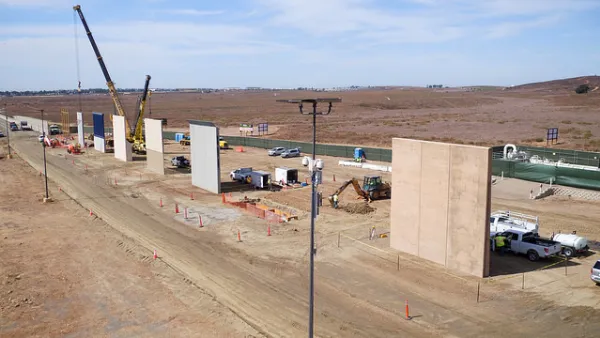
Report: Trump Willing to Break the Rules to Build Border Wall
Transit agencies, affordable housing developers, and many others might be envious of the kind of leeway sources say President Trump is willing to grant in the name of project delivery.
Homeland Security Waives More Than 30 Laws to Expedite Border Wall
In the drive to begin construction in New Mexico, the Trump Administration has bypassed dozens of federal environmental regulations.

Planetizen Federal Action Tracker
A weekly monitor of how Trump’s orders and actions are impacting planners and planning in America.

The state-sanctioned urbicide of Austin
People don’t kill cities. Freeways do.

US to reduce Colorado River water deliveries to Mexico
A new Colorado Treaty amendment reduces Mexico’s Colorado River water allocation by 250,000 acre feet.

Mamdani overhauls NYC's Vision Zero plan with 100 new policy goals
The overhaul aims to reduce traffic deaths and make streets safer for pedestrians, cyclists and drivers through lower speed limits, new safety infrastructure and more.

Amtrak not solely to blame for New Jersey commuter rail's unreliability, report finds
A new study from the Garden State Initiative found that NJ Transit’s budget grew 20% across a 4 year period, but reliability declined significantly over the same period.

EPA erases limits on planet-warming pollution from power plants
Under Monday’s plan, power plants would still have some limits on how much mercury, arsenic and other contaminants they can emit.

FREE Course: Walkable City 1: Why Walkability?
After describing his path towards focusing on walkability as the essence of good planning, Jeff Speck marches through his five principal reasons for making more walkable places.
Reinventing Malls: Planning Alchemy—Turning Gray Fields Into Gold
The course focuses on the opportunities and imperatives that shape reinvention of mall sites.

Eagle County Government
Harvard University Graduate School of Design
Nashville Planning Department
The Architects Foundation
University of Cincinnati Online
The Pocatello Development Authority
The Urban Renewal Agency of the City of Pocatello
Journal of the American Planning Association