The Arctic blast that shut down power to millions of Texas households last week has brought renewed attention to the isolated Texas power grid that prevented the operator from importing out-of-state electricity.


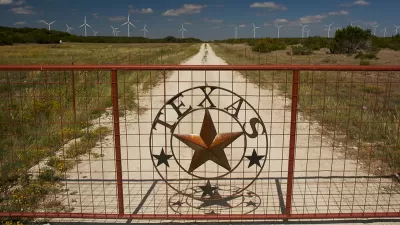
There are three power grids in the lower 48 states: the Eastern Interconnection, the Western Interconnection, and the Texas Interconnection.
Kate Galbraith, the former energy and environment reporter for The Texas Tribune, penned a go-to piece about the uniqueness of Texas having its own power grid that's as relevant today as it was when she wrote it ten years ago after an Arctic blast shut down 152 generating units, 28% of the generators that supplied electricity to the power grid operated by the Electric Reliability Council of Texas (ERCOT).
Asher Price, also an energy and the environment reporter who has been covering Winter Storm 2021 for the Austin American-Statesman, referenced Galbraith in her own piece (source article) published Feb. 16 explaining the roots of what Bill Magness, CEO of ERCOT, the electric grid operator for 90 percent of the Lone Star State, calls "an electrical island in the United States."
The reasons Texas controls its own grid, the journalist Kate Galbraith observed in a Texplainer piece for the Texas Tribune in 2011 have to do with the same theme that colors so much of Texas' history and public policy: a distrust of federal interference.
"Texas' secessionist inclinations have at least one modern outlet: the electric grid," wrote Galbraith on Feb. 8, 2011, six days after "Texas imposed statewide rolling blackouts for only the second time in over two decades."
Before ERCOT
ERCOT's predecessor was the Texas Interconnected System which was formed, in part, to stay out the reach of the Federal Power Commission which was charged with overseeing interstate electricity sales after President Franklin D. Roosevelt signed the Federal Power Act that changed the name of the 1920 Federal Water Power Act.
"The ERCOT grid remains beyond the jurisdiction [pdf] of the Federal Energy Regulatory Commission, which succeeded the Federal Power Commission and regulates interstate electric transmission," adds Galbraith.
Bottom line: Texas has its own grid to avoid dealing with the feds.
Price adds:
"Utilities in Texas were smart and made an agreement that no one was going to extend power outside of Texas," Donna Nelson, who served as chair of the state Public Utility Commission, which oversees ERCOT, from 2008 to 2017, said in an ERCOT promotional video about the history of the grid.
Not extending power outside of Texas also meant that during Winter Storm 2011, ERCOT was not able to import electricity from the Eastern and Western Interconnections, one of the reasons why 4.3 million Texans lost power last week and dozens of people died.
Related in Planetizen:
-
Blaming ERCOT, Feb. 22, 2021
-
California-Style Rolling Blackouts Come to Texas, Feb. 18, 2021
-
Bridging the Divides in the U.S. Electricity Grid, August 9, 2018
Read the full story: Why is Texas the only state with its own power grid?
Blaming ERCOT
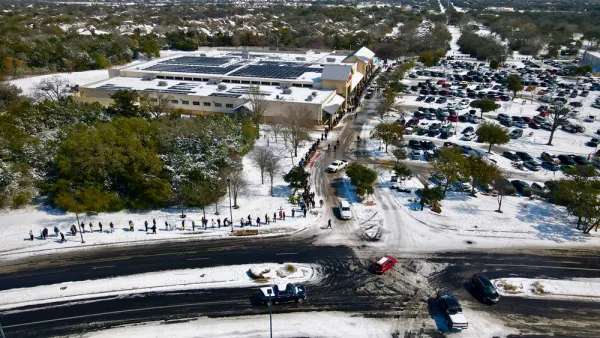
The Electric Reliability Council of Texas (ERCOT), the nonprofit, independent power grid operator for 90 percent of the nation's second-largest state, has become the convenient fall guy for the epic power failure caused by an extreme weather event.
Texas Grid Operator to Be Investigated by Congressional Subcommittee
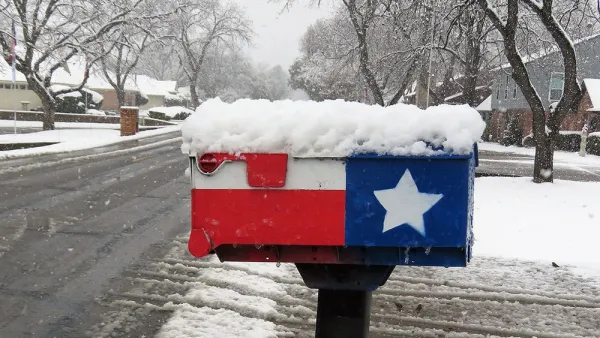
Texas' costliest natural disaster will be the subject of a congressional investigation by a House Oversight subcommittee thanks to Rep. Ro Khanna, D-Calif., who is concerned about ERCOT's lack of preparation for extreme winter weather.
Court Denies Lawsuits Over Texas Power Grid Failure
The state’s Supreme Court ruled the non-profit ERCOT can’t be sued for damages caused during blackouts in the 2021 winter storm.

Planetizen Federal Action Tracker
A weekly monitor of how Trump’s orders and actions are impacting planners and planning in America.

California plans to bury El Niño’s downpour
If the state plays its cards right, it may be able to store a billion acre-feet of El Niño’s water in aquifers.

Desperate measures: Advocates weigh draining Lake Powell to fill Colorado River
Draining the reservoir could reduce evaporation losses by a couple hundred thousand acre-feet.

US buildings threatened, destroyed by fires set to triple by 2060
Researchers found a high fire risk for socioeconomically vulnerable neighborhoods in the American West.

LA residents may be allowed to paint their own crosswalks
Councilwoman Katy Yaroslavsky put out a motion instructing the Los Angeles Department of Public Transportation to study the feasibility of allowing volunteers to paint crosswalks.

Dallas moves to overhaul its zoning code
The city's zoning reform will allow more multi-family and mixed-use developments.

FREE Course: Walkable City 1: Why Walkability?
After describing his path towards focusing on walkability as the essence of good planning, Jeff Speck marches through his five principal reasons for making more walkable places.
Reinventing Malls: Planning Alchemy—Turning Gray Fields Into Gold
The course focuses on the opportunities and imperatives that shape reinvention of mall sites.

City of Rosemead
Rutgers University, Edward J. Bloustein School of Planning and Public Policy
One Hundred Miles
Hunter College, City University of New York (CUNY)
The Architects Foundation
University of Cincinnati Online
City of Cambridge
Montrose County
The Pocatello Development Authority