The Economic Innovation Group has released its 2020 Distressed Communities Index.


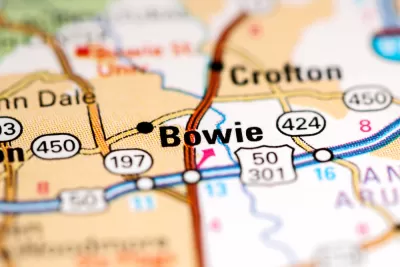
"A shocking 70% of the nation’s 1,036 majority-Black ZIP codes are considered 'distressed,' while only 19 — 1.8% — rank as 'prosperous,'" according to an article by Andy Olin.
Olin cites the most recent Distressed Communities Index (DCI) from the Economic Innovation Group (EIG), in addition to focusing on the fact that two of the prosperous zip codes are located in Fort Bend County, Texas.
"Distressed communities are characterized by widespread poverty, high rates of unemployment and low levels of educational attainment. They also face stagnant or negative economic growth, which means little to no change in the prospects of those who live there," according to Olin's explanation.
"The seven metrics used to calculate a community’s score on the index were no high school diploma, housing vacancy rate, adults not working, poverty rate, median income ratio, change in employment and change in business establishments." Four out of the five most prosperous majority-Black ZIP codes in the country are located in Maryland, according to these metrics.
In total, the report estimates that 50.5 million Americans live in distressed zip codes, compared to 50 million in 2016. The report makes the case that the gap between prosperous and distressed grew in the United States over the course of the past decade, but despite the high ratio of distressed majority-Black ZIP codes, the share of the U.S. Black population living in distressed zip codes dropped between 2010 and 2018, according to the report.
FULL STORY: There are only 19 prosperous majority-Black ZIP codes in the US. The Houston area is home to two

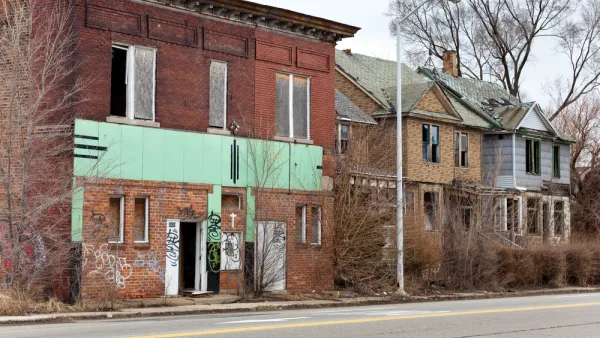
A Better Way to Tackle Social and Economic Inequality
Building community wealth from the bottom up is a more effective way to turn struggling communities around.
A Map of the Most Economically Distressed Communities in the United States
The economic recovery of recent years has not reached all corners of the country—it hasn’t even reached all corners of many cities. A new report plots a new map of the nation's distressed communities.
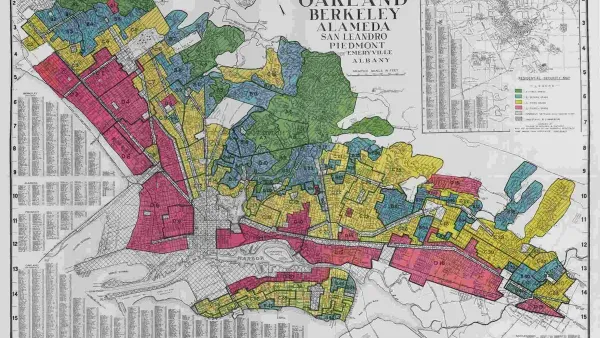
Rethinking Redlining
For decades we have blamed 100-year-old maps for the patterns of spatial racial inequity that persist in American cities today. An esteemed researcher says: we’ve got it all wrong.

Planetizen Federal Action Tracker
A weekly monitor of how Trump’s orders and actions are impacting planners and planning in America.

The state-sanctioned urbicide of Austin
People don’t kill cities. Freeways do.

US to reduce Colorado River water deliveries to Mexico
A new Colorado Treaty amendment reduces Mexico’s Colorado River water allocation by 250,000 acre feet.

Mamdani overhauls NYC's Vision Zero plan with 100 new policy goals
The overhaul aims to reduce traffic deaths and make streets safer for pedestrians, cyclists and drivers through lower speed limits, new safety infrastructure and more.

Amtrak not solely to blame for New Jersey commuter rail's unreliability, report finds
A new study from the Garden State Initiative found that NJ Transit’s budget grew 20% across a 4 year period, but reliability declined significantly over the same period.

EPA erases limits on planet-warming pollution from power plants
Under Monday’s plan, power plants would still have some limits on how much mercury, arsenic and other contaminants they can emit.

FREE Course: Walkable City 1: Why Walkability?
After describing his path towards focusing on walkability as the essence of good planning, Jeff Speck marches through his five principal reasons for making more walkable places.
Reinventing Malls: Planning Alchemy—Turning Gray Fields Into Gold
The course focuses on the opportunities and imperatives that shape reinvention of mall sites.

Eagle County Government
Harvard University Graduate School of Design
Nashville Planning Department
The Architects Foundation
University of Cincinnati Online
The Pocatello Development Authority
The Urban Renewal Agency of the City of Pocatello
Journal of the American Planning Association