U.S. PIRG has released the latest edition of the Highway Boondoggles report, the sixth edition of the report published since 2014.


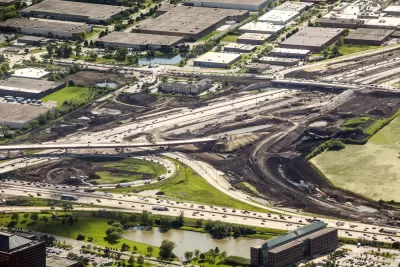
The reasons for transportation planners and engineers to heed the warnings of the Highway Boondoggles 6 report, published this week by U.S. PIRG are legion. Here's how the website that shares the new report states the crises facing car-centric transportation in the United States:
America’s aging roads and bridges are in increasingly dire need of repair. Tens of thousands of people die on the roads each year and more are sickened or die from air pollution caused by vehicles. Tens of millions of Americans lack access to quality public transit or safe places to walk or bike, leaving them fully dependent on cars or – for those who cannot afford a car or are physically unable to drive – entirely shut off from critical services and opportunities.
Add that toxic mess to the economic crisis created by the coronavirus pandemic, and "Now is no time to fritter away scarce public resources on wasteful boondoggle projects."
Planetizen has noticed a spate of recent news about state and regional authorities gearing up to expand and extend highways—in defiance of these various warnings. (Click through to see the rest of the thread on the source Tweet.)
Calling attention to the recent spate of news regarding massive highway widening projects around the United States.
— James Brasuell (@CasualBrasuell) November 11, 2020
Highway Boondoggles 6 focuses on seven new projects, singling out Florida's Multi-use Corridors of Regional Economic Significance (M-Cores) program as the most potentially destructive. "This $10 billion, 330-mile, multi-highway construction project, would strain the state’s already overstretched budget in addition to impacting some of Florida’s last remaining undeveloped lands, threatening the endangered Florida panther with extinction," according to the U.S. PIRG statement. "Despite cutting $1 billion from the budget in response to the COVID-19 pandemic, the state’s 2020-21 budget, approved by Gov. Ron DeSantis, still includes $90 million for M-CORES."
Matt Casale, director of U.S. PIRG Environment Campaigns Director, says a shift in transportation spending could be a key tool in a post-pandemic economic recovery. "If we’re smarter about how we spend our transportation dollars and focus instead on building a 21st-century transportation system, America can build a better world coming out of the COVID-19 pandemic, one with less pollution, less gridlock and more public and active transit," said Caale in an emailed statement.
Now that the Highway Boondoggles report has built up a little bit of an archive, it's also possible to evaluate the outcomes of the 60 projects profiled in previous editions of the report. An interactive map offers insight into these projects on the U.S. PIRG website. A few of the 60 projects have been canceled, but most are under construction or under study and review).
Highway Boondoggles 6 also includes an evaluation of one such project: the I-94 expansion project in Milwaukee.
"This project serves as a reminder that wasteful highway construction projects can still be revived by incoming state legislators even after scheduled work and funding approval have been rescinded," according to the U.S. PIRG. "The project’s resurrection and over $1 billion price tag also comes amid budget shortfalls related to the COVID-19 pandemic: Wisconsin has suffered steep decreases in revenue and in July, Gov. Evers ordered state agencies to cut their budgets by $250 million."
The latest news shared by Planetizen on the Interstate 94 plans was written by a coalition of environmentalists in Wisconsin who describe the project as a "fiasco" and call on Wisconsin Governor Tony Evers to pull the plug.
Read the full story: Highway Boondoggles 6

Reconciling Highway Investments With Climate Plans
The Colorado Department of Transportation has plans to expand highways, but it also has a mandate to reduce emissions from the state's transportation systems. Is it possible to do both?
Florida Highway Project Faces Opposition From All Sides
Critics worry the proposed 330-mile corridor would encourage sprawl, harm wildlife, and saddle the state with decades of debt.

The Biggest Highway Boondoggles in the United States
Frontier Group and U.S. PIRG have released the fifth edition of its Highway Boondoggles report.

Planetizen Federal Action Tracker
A weekly monitor of how Trump’s orders and actions are impacting planners and planning in America.

California plans to bury El Niño’s downpour
If the state plays its cards right, it may be able to store a billion acre-feet of El Niño’s water in aquifers.

Chicago breaks ground on $3 billion megadevelopment
The new neighborhood, titled Foundry Park, will one day host 3,700 residences.

Satanic place names
From streams and lakes to valleys and canyons, I mapped more than 1,000 places named after the Devil.

California High-Speed Rail Authority CEO resigns after $600,000 scandal
Under Ian Choudri, the authority used taxpayer dollars to fund first class flights and trips to nightclubs.

Want to study the Missouri River? Soon, you may need unanimous approval from 10 states
Legislation would require 10 governors’ permission to study or build projects moving water outside the basin.

FREE Course: Walkable City 1: Why Walkability?
After describing his path towards focusing on walkability as the essence of good planning, Jeff Speck marches through his five principal reasons for making more walkable places.
Reinventing Malls: Planning Alchemy—Turning Gray Fields Into Gold
The course focuses on the opportunities and imperatives that shape reinvention of mall sites.

City of Rosemead
Rutgers University, Edward J. Bloustein School of Planning and Public Policy
One Hundred Miles
Hunter College, City University of New York (CUNY)
The Architects Foundation
University of Cincinnati Online
City of Cambridge
Montrose County
The Pocatello Development Authority