It has a long way to go to match the speed and capacity of high-speed rail technology, but at least the Hyperloop has achieved one critical benchmark: a test involving human passengers.


"Virgin Hyperloop announced that for the first time it has conducted a test of its ultra-fast transportation system with human passenger," reports Andrew J. Hawkins.
"The test took place on Sunday afternoon at the company’s DevLoop test track in the desert outside Las Vegas, Nevada," according to Hawkins. "The first two passengers were Virgin Hyperloop’s chief technology officer and co-founder, Josh Giegel, and head of passenger experience, Sara Luchian."
The pod achieved a speed of 100 mph on the 500-meter-long track. "The company says it has conducted over 400 tests on that track, but never before with human passengers — until [November 8]," according to Hawkins.
The article includes details of how far the technology has to go to reach its theoretical potential—or even the reality of existing high-speed rail technology.
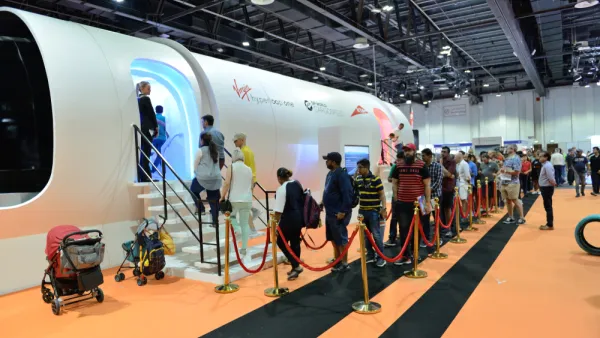
Virgin Hyperloop since released video of the test on YouTube, shown above.
Various media outlets picked up news of the test, including Smart Cities Dive and CNN Business.
Read the full story: Virgin Hyperloop Hits an Important Milestone: The First Human Passenger Test
The Hyperloop’s Prospects Dim
The media is coming around to the idea that the hyperloop is not a near-term solution for the country’s transportation woes. It’s too little, too obvious, too late.
Virgin Hyperloop Shifts to Cargo Transport, Lays Off Staff
The company sees cargo as a more promising and cost-efficient use of its technology.

West Virginia Wins Bid for Location of Virgin Hyperloop Facility
Virgin Hyperloop's Hyperloop Certification Center (HCC) will be located on an 800-acre site straddling Tucker and Grant counties in West Virginia.

Planetizen Federal Action Tracker
A weekly monitor of how Trump’s orders and actions are impacting planners and planning in America.

California plans to bury El Niño’s downpour
If the state plays its cards right, it may be able to store a billion acre-feet of El Niño’s water in aquifers.

Desperate measures: Advocates weigh draining Lake Powell to fill Colorado River
Draining the reservoir could reduce evaporation losses by a couple hundred thousand acre-feet.

Chicago voters approve permanent festival grounds, penalty for vacant property owners
Currently, major summer and fall festivals take over public parks for weeks at a time, drawing criticism from nearby residents

NYC votes to cut outdoor dining red tape, speed up permitting
New York City also voted to allow the Department of Transportation to begin work on urgent projects before notifying elected officials.

California appears to reject Prop. 45
The proposition would have expanded the projects that qualify for a streamlined environmental review, effectively paring down the California Environmental Quality Act.

FREE Course: Walkable City 1: Why Walkability?
After describing his path towards focusing on walkability as the essence of good planning, Jeff Speck marches through his five principal reasons for making more walkable places.
Reinventing Malls: Planning Alchemy—Turning Gray Fields Into Gold
The course focuses on the opportunities and imperatives that shape reinvention of mall sites.

City of Rosemead
Rutgers University, Edward J. Bloustein School of Planning and Public Policy
One Hundred Miles
Hunter College, City University of New York (CUNY)
The Architects Foundation
University of Cincinnati Online
City of Cambridge
Montrose County
The Pocatello Development Authority