So many highly anticipated bike facilities finally deliver only to fall short of real game changing status. Seattle provides the latest example of the phenomenon in the wild.


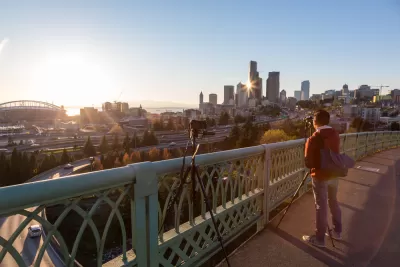
The Seattle Department of Transportation (SDOT) recently started construction on a protected bike lane "across the Dr. Jose Rizal Bridge on 12th Avenue South between Little Saigon and north Beacon Hill," reports Ryan Packer.
The new protected bike lane is both a significant improvement and a missed opportunity, according to Packer's assessment: "This will be the first segment of a safe bicycle connection running throughout Beacon Hill expected to be completed by 2023, but the 12th Avenue South segment going in this year will stop short of making some tantalizingly close connections to existing facilities."
The street configuration on the ridge was improved during consultation with the public, reports Packer, resulting in a reduced number of automobile lanes and bike lanes on both sides of the street. But the lack of a connection to the rest of the city's protected bike lane network irks Packer, and there are no plans to bridge the gap.
The article includes a lot more detail about the new bike lane, including both additional positive assessments and a level of analysis rarely seen in discussions of planning and infrastructure on the Internet.
FULL STORY: Construction Starts on Beacon Hill-to-Downtown Bike Connection

Better Bike Plan 2025 Adopted in San Jose
California's third most populous city has a new plan to add hundreds of miles of protected bike lanes.
Seattle Hoping to Extend a Successful Traffic Safety Project
After repainting the lanes on Rainier Avenue in Seattle, the street works better for everyone. If it's that easy, why isn't the model implemented more widely?
Checking in on Two of Seattle's Bike Infrastructure Plans
The city of Seattle is moving through the planning and design stages on two important bike infrastructure projects located at the south end of Downtown.

The state-sanctioned urbicide of Austin
People don’t kill cities. Freeways do.

US to reduce Colorado River water deliveries to Mexico
A new Colorado Treaty amendment reduces Mexico’s Colorado River water allocation by 250,000 acre feet.

New Jersey’s second-largest city bans standalone data centers
Jersey City will continue to allow co-location facilities, such as those meant for research institutions that store their own data.

Amtrak not solely to blame for New Jersey commuter rail's unreliability, report finds
A new study from the Garden State Initiative found that NJ Transit’s budget grew 20% across a 4 year period, but reliability declined significantly over the same period.

EPA erases limits on planet-warming pollution from power plants
Under Monday’s plan, power plants would still have some limits on how much mercury, arsenic and other contaminants they can emit.

Phoenix announces new on-demand transit service, more frequent RAPID buses
Both new services will launch in October, and are part of Phoenix's Project Effective Access Solutions for Easing Congestion.

FREE Course: Walkable City 1: Why Walkability?
After describing his path towards focusing on walkability as the essence of good planning, Jeff Speck marches through his five principal reasons for making more walkable places.
Reinventing Malls: Planning Alchemy—Turning Gray Fields Into Gold
The course focuses on the opportunities and imperatives that shape reinvention of mall sites.

Eagle County Government
Harvard University Graduate School of Design
Nashville Planning Department
The Architects Foundation
University of Cincinnati Online
The Pocatello Development Authority
The Urban Renewal Agency of the City of Pocatello
Journal of the American Planning Association