Elected officials in San Francisco and Santa Clara counties have produced a counter proposal after killing a proposed sales tax last week.


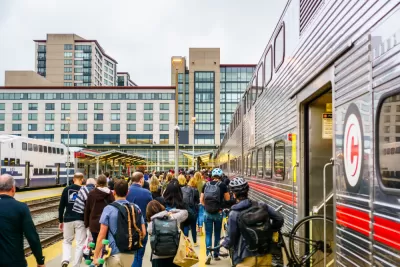
"A new proposal to save the 160-year-old Caltrain rail line was released by elected officials in San Francisco and Santa Clara County on Tuesday as supervisors there attempt to use the potential death of the transit agency as leverage in a power struggle with San Mateo County," reports Aldo Toledo.
According to Toledo, "the Caltrain governing board could be significantly changed under a new proposal signed by Mayors Sam Liccardo and London Breed, as well some members of both boards of supervisors." Changes in governance were key to a controversial vote by San Francisco Supervisors last week to kill a proposed sales tax to fund an expansion of service on the commuter rail system. Now the sales tax measure is being touted as a funding measure to help Caltrain weather the fiscal crisis created by the pandemic.
The article includes more details about the governance structure of Caltrain, and how the new proposal would change the equation.
Between the vote and the new proposal, San Francisco County Supervisor Aaron Peskin created a stir on social media by claiming that San Mateo County officials are exaggerating the existential threat to Caltrain.
I know the San Mateo PR machine would like advocates to think that Caltrain is all but dead but it’s literally just factually untrue.
We’ll continue to pay our fair share to supporting its essential functions, though our top priority has to be Muni.— Aaron Peskin (@AaronPeskin) July 16, 2020
>
Read the full story: New Caltrain lifeline proposal could include changes to the agency’s governing structure
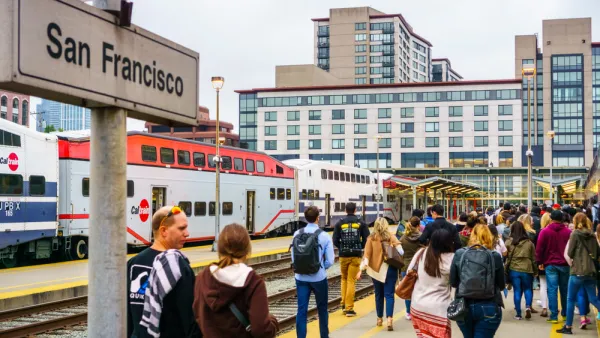
Compromise Reached to Save Caltrain
The saga of the three-county sales tax upon which the future of Caltrain depends is now in the hands of voters.
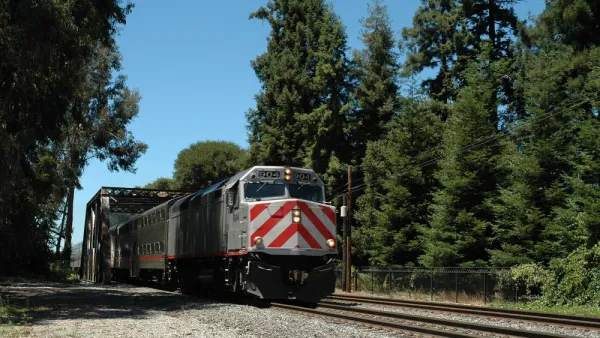
Caltrain on the Rocks as Sales Tax Measure Fails
Advocates are concerned about the possibility of Caltrain entirely shutting down—less than a year after the commuter rail line seemed positioned for a massive expansion of service.
One Rail System to Ring the Bay Area? Supporters See Reasons for Optimism
A plan to integrate the various regional transit providers in the San Francisco Bay Area could be the key to winning back transit riders in the post-pandemic world.

Planetizen Federal Action Tracker
A weekly monitor of how Trump’s orders and actions are impacting planners and planning in America.

California plans to bury El Niño’s downpour
If the state plays its cards right, it may be able to store a billion acre-feet of El Niño’s water in aquifers.

Desperate measures: Advocates weigh draining Lake Powell to fill Colorado River
Draining the reservoir could reduce evaporation losses by a couple hundred thousand acre-feet.

Mamdani’s pied-à-terre tax survives legal challenge
A panel of judges found that the plaintiffs failed to demonstrate injury as a result of New York City's implementation of the tax.

Eastern Nebraska is running out of electricity
Data centers and electrification are straining eastern Nebraska’s grid, throttling economic development.

Seattle passes record-breaking transit services expansion
Proposition 1 will double the city’s transit tax to add 95,000 more bus trips and preserve 180,000 bus trips annually.

FREE Course: Walkable City 1: Why Walkability?
After describing his path towards focusing on walkability as the essence of good planning, Jeff Speck marches through his five principal reasons for making more walkable places.
Reinventing Malls: Planning Alchemy—Turning Gray Fields Into Gold
The course focuses on the opportunities and imperatives that shape reinvention of mall sites.

City of Rosemead
Rutgers University, Edward J. Bloustein School of Planning and Public Policy
One Hundred Miles
University of Michigan School for Environment and Sustainability (SEAS)
Hunter College, City University of New York (CUNY)
The Architects Foundation
City of Cambridge
Montrose County
The Pocatello Development Authority