Ocean Drive in South Beach is the site of an ongoing pilot project in making space for pedestrians and businesses in space previously devoted to cars. Advocates and some local politicians don't like the direction that the experiment is headed.


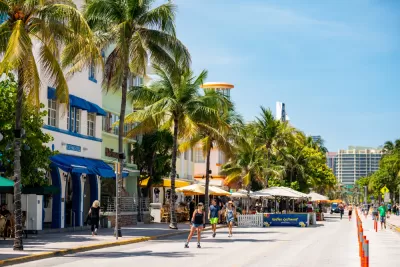
"For nearly eight weeks, a sliver of South Beach belonged to the people," writes Martin Vassolo. "There were no cars allowed on a 10-block stretch of Ocean Drive, the popular seaside promenade, giving bicyclists, skateboarders, joggers and walkers a space to exercise away from cramped sidewalks and congested roads."
Now that has changed, however, after the city returned cars to the northbound lanes on Ocean Drive over the 4th of July weekend, while retaining the southbound lanes for pedestrians and outdoor dining, in what promises to be an ongoing experiment in reconfiguring the public realm in response to ongoing crises of public health and the local economy.
"Mayor Dan Gelber said the street’s new configuration will not be permanent, calling it a 'two-week pilot' program," according to Vassolo. "Ideally, he said, the city should be able to fully pedestrianize the street during certain periods, and open it to cars the rest of the time."
Activists, however, are still pushing back on the decision to allow cars back onto the street. "Activists aren’t the only ones perplexed by the city’s decision to reopen Ocean Drive. Commissioners Ricky Arriola and Mark Samuelian, who supported the closure of the street, said on Friday they were not consulted about the plan," reports Vassolo.
Additional coverage of the ongoing Ocean Drive saga is available from Joshua Ceballos.
FULL STORY: Ocean Drive was closed to cars for eight weeks. Miami Beach is reopening a lane of traffic


Pedestrians Briefly Take Back Miami Beach's Ocean Drive
Miami Beach reopened Ocean Drive to vehicles earlier this year at the request of hotel owners. So many pedestrians showed up to the famous street on a weekend earlier this month, however, that cars were blocked once again.

New York Outdoor Dining, Open Streets Programs Now Permanent
New York City will now be measurably less car-centric for the indefinite future.
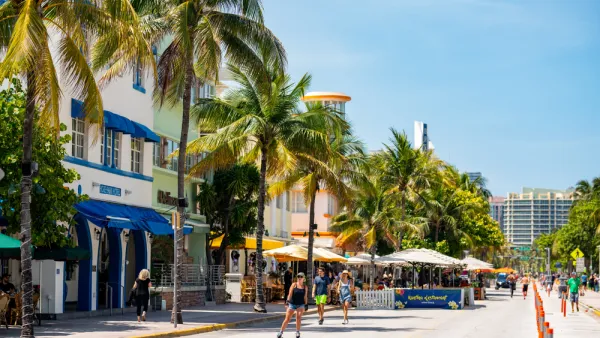
Miami Beach to Reopen Ocean Drive to Cars
The famous cruising strip was off-limits to cars during the pandemic. Now, the city is letting vehicles return with some pedestrian-oriented compromises.

The state-sanctioned urbicide of Austin
People don’t kill cities. Freeways do.

US to reduce Colorado River water deliveries to Mexico
A new Colorado Treaty amendment reduces Mexico’s Colorado River water allocation by 250,000 acre feet.

New Jersey’s second-largest city bans standalone data centers
Jersey City will continue to allow co-location facilities, such as those meant for research institutions that store their own data.

Amtrak not solely to blame for New Jersey commuter rail's unreliability, report finds
A new study from the Garden State Initiative found that NJ Transit’s budget grew 20% across a 4 year period, but reliability declined significantly over the same period.

EPA erases limits on planet-warming pollution from power plants
Under Monday’s plan, power plants would still have some limits on how much mercury, arsenic and other contaminants they can emit.

Phoenix announces new on-demand transit service, more frequent RAPID buses
Both new services will launch in October, and are part of Phoenix's Project Effective Access Solutions for Easing Congestion.

FREE Course: Walkable City 1: Why Walkability?
After describing his path towards focusing on walkability as the essence of good planning, Jeff Speck marches through his five principal reasons for making more walkable places.
Reinventing Malls: Planning Alchemy—Turning Gray Fields Into Gold
The course focuses on the opportunities and imperatives that shape reinvention of mall sites.

Eagle County Government
Harvard University Graduate School of Design
Nashville Planning Department
The Architects Foundation
University of Cincinnati Online
The Pocatello Development Authority
The Urban Renewal Agency of the City of Pocatello
Journal of the American Planning Association